TLDR
Retrieval-Augmented Generation (RAG) is the architectural standard for grounding Large Language Models (LLMs) in authoritative, external datasets. By decoupling a model's Parametric Memory (internal weights) from Non-Parametric Memory (external databases), RAG transforms LLMs from "stochastic parrots" into verifiable reasoning engines. This foundational framework addresses the three critical failures of standalone models: Staleness, Hallucinations, and Lack of Private Context. For the technical decision-maker, RAG represents a shift from "System 1" (instinctive, probabilistic) to "System 2" (deliberative, grounded) AI operations, offering a 20-22% improvement in reasoning performance and up to a 3x increase in factual accuracy over standard inference.
Conceptual Overview
To architect a modern AI system, one must first navigate the Optimization Trilemma: the balance between Accuracy, Cost, and Latency. Standard LLM generation relies on a single-pass inference mechanism where the model predicts the next token based solely on its training data. This is inherently limited by the "Knowledge Cutoff"—the date the model's training ended.
The Systems View: Parametric vs. Non-Parametric
The core of RAG lies in the synergy between two distinct memory paradigms:
- Parametric Memory: The knowledge encoded within the model's weights during pre-training. It is efficient for linguistic patterns but static and prone to "hallucinations" when encountering gaps.
- Non-Parametric Memory: The external knowledge base (typically a Vector Database). It is dynamic, easily updatable, and serves as the "source of truth."
By implementing RAG, the LLM's role shifts from being a Knowledge Base to a Reasoning Engine. The model no longer needs to "remember" facts; it only needs to "reason" over the facts provided in its context window.
The Evolution of Grounding
Historically, AI moved from "closed-book" models to the hybrid architecture proposed by Meta AI in 2020. This evolution has progressed through four distinct stages:
- Naive RAG: A basic "Retrieve-and-Read" pipeline.
- Advanced RAG: Incorporates pre-retrieval query transformations and post-retrieval re-ranking.
- Modular RAG: Introduces specialized modules for routing and search.
- Agentic RAG: Utilizes self-reflection and multi-hop reasoning to handle complex, iterative queries.
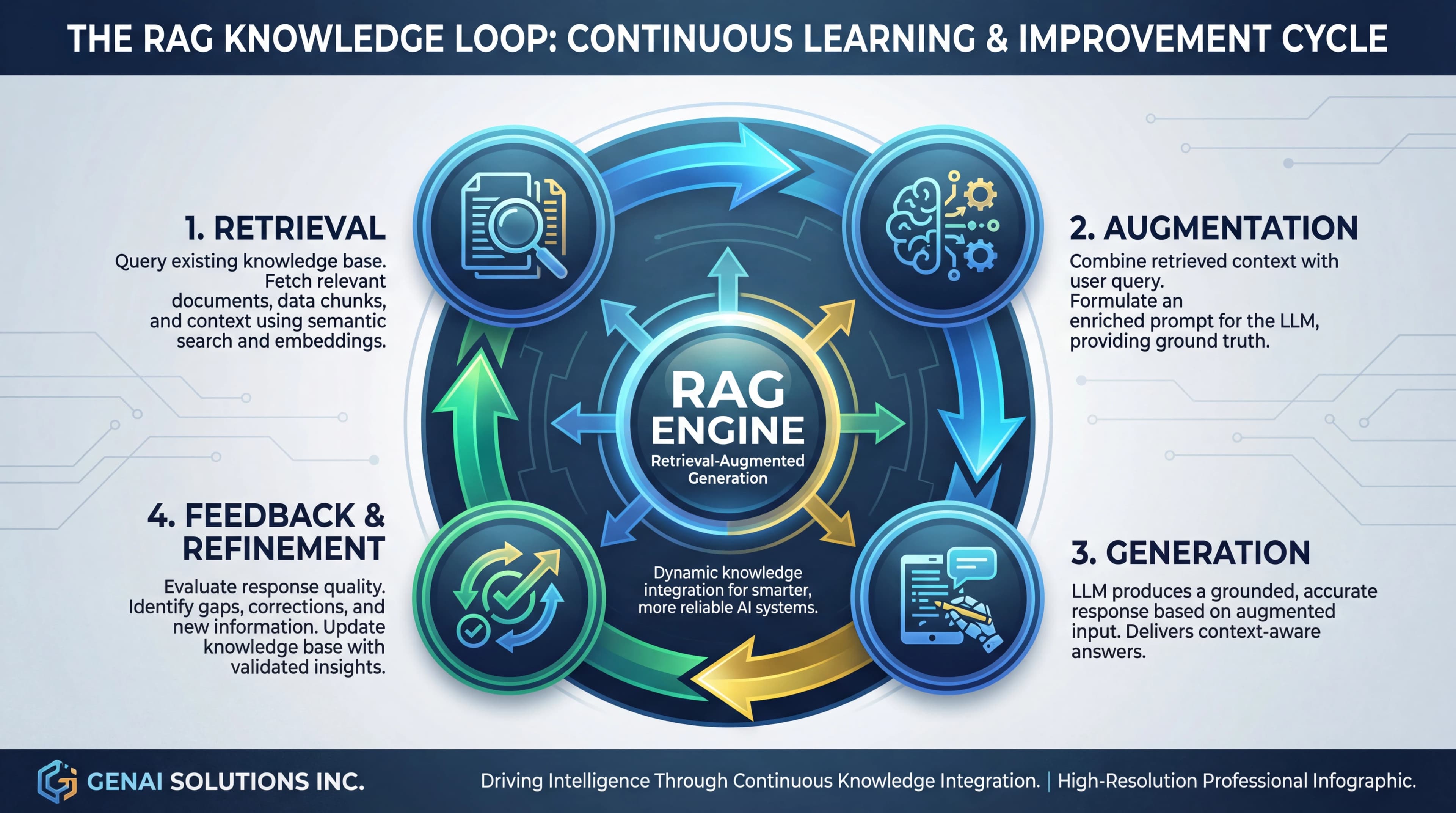 The RAG Knowledge Loop: Iterative Retrieval-Augmented Generation
- User Query enters the system.
- Retriever queries the Vector Database (Non-Parametric Memory).
- Contextual Chunks are returned and combined with the original query.
- Augmented Prompt is sent to the LLM (Reasoning Engine).
- Grounded Response is generated with Citations, feeding back into the user interface.
Practical Implementations
Implementing a production-grade RAG system requires a transition from traditional ETL (Extract, Transform, Load) to a specialized AAG (Augment, Adapt, Generate) framework.
The Preparation Phase: Indexing
Before retrieval can occur, unstructured data (PDFs, Slack logs, Databases) must be converted into a machine-readable format.
- Chunking: Breaking documents into semantically meaningful segments.
- Embedding: Using an embedding model to convert text into high-dimensional vectors.
- Storage: Indexing these vectors in a database (e.g., Pinecone, Milvus) where semantic similarity is measured by geometric distance (Cosine Similarity or Euclidean Distance).
The Execution Phase: Retrieval and Augmentation
When a user submits a query, the system performs a similarity search to find the most relevant "signal" amidst the noise.
- Retrieval: Fetching the top-$k$ relevant chunks.
- Augmentation: Programmatically enriching the user's prompt with these chunks. This process reduces Entropy by narrowing the model's statistical search space to the provided evidence.
Model Selection Strategies
Choosing the right model for the "Generator" role involves the Bias-Variance Tradeoff. A model that is too simple (High Bias) may fail to synthesize complex context, while a model that is too complex (High Variance) may over-interpret noise in the retrieved documents. Modern strategies involve Dynamic Model Selection (DMS), where queries are routed to different models based on complexity and cost.
Advanced Techniques
As RAG systems mature, architects must choose between three primary optimization methodologies: Prompting, RAG, and Fine-Tuning.
The Optimization Axis
- Prompting: Best for general tasks. It involves iterative instruction refinement and A (Comparing prompt variants) to guide the model.
- RAG: The industry standard for dynamic or proprietary data. It decouples knowledge from reasoning.
- Fine-Tuning: The "last mile" for specialized behaviors, niche terminology, and strict formatting.
Advanced RAG Taxonomy
To handle enterprise-grade complexity, systems often move beyond Naive RAG:
- Query Transformation: Rewriting a user's vague query into a more "retrievable" format.
- Re-ranking: Using a secondary, more expensive model to ensure the most relevant retrieved chunks are placed at the top of the context window (addressing the "Lost in the Middle" phenomenon).
- Knowledge Graph Integration: Moving beyond vector similarity to capture structured relationships between entities, enabling "multi-hop" reasoning (e.g., "How does Project X affect the budget of Department Y?").
Research and Future Directions
The frontier of RAG research focuses on Self-Correction and Agentic Frameworks.
Reducing Hallucinations via Grounding
Hallucinations occur when the model's objective function (maximizing token probability) overrides factual accuracy. RAG provides a "verifiable anchor." Future systems are moving toward Reflexion agents, which have demonstrated a 91% pass@1 accuracy on coding benchmarks by "checking their work" against retrieved documentation before finalizing an output.
The Shift to "Compound AI Systems"
We are moving away from monolithic models toward systems that combine:
- Fine-Tuning for specific behavioral personas.
- RAG for real-time factual grounding.
- Advanced Prompting (utilizing A) for orchestration.
This modularity ensures that the system remains flexible, cost-effective, and, most importantly, trustworthy.
Frequently Asked Questions
Q: How does RAG specifically mitigate the "Knowledge Cutoff" problem?
RAG bypasses the cutoff by never requiring the model to "know" the information internally. Instead, the system retrieves the most recent data (e.g., a news article from five minutes ago) and provides it as "context" in the prompt. The LLM then uses its reasoning capabilities to summarize or answer based on that fresh data.
Q: When should I use Fine-Tuning instead of RAG?
Use Fine-Tuning if you need the model to learn a specific style, vocabulary, or output format (e.g., talking like a specific brand or outputting strict JSON). Use RAG if you need the model to have access to specific facts or dynamic data that changes frequently. Fine-tuning is for "how to talk," RAG is for "what to say."
Q: What is the "Lost in the Middle" phenomenon in RAG?
Research has shown that LLMs are better at processing information at the very beginning or very end of a long context window. If the most relevant information is buried in the middle of 20 retrieved chunks, the model may ignore it. This is why Re-ranking is a critical advanced technique.
Q: How does "A" (Comparing prompt variants) improve RAG performance?
A allows developers to test how different instructions (e.g., "Only use the provided context" vs. "Use the context and your general knowledge") affect the grounding of the output. By systematically comparing these variants, architects can find the prompt structure that most effectively suppresses hallucinations for their specific dataset.
Q: Does RAG increase inference latency?
Yes. Because RAG requires an additional step (searching a database) before the LLM can start generating, it introduces latency. However, this is usually offset by the massive gains in accuracy and the fact that RAG is significantly cheaper and faster than retraining or fine-tuning a model every time new data arrives.
References
- Lewis et al. (2020) Retrieval-Augmented Generation for Knowledge-Intensive NLP Tasks
- Dual-Process Theory in LLM Reasoning
- The Bias-Variance Tradeoff in Foundation Models