TLDR
By late 2025, the Vector Database landscape has matured from a collection of niche algorithmic libraries into a foundational pillar of the AI infrastructure stack. The market has bifurcated into two primary architectural philosophies: Serverless Cloud-Native (optimized for cost-efficiency and ease of use) and Modular Open-Core (optimized for flexibility and data sovereignty). The critical evolution in this space is the transition from simple similarity search to Hybrid Query Execution, where high-dimensional vector retrieval is constrained by deterministic metadata filtering. Choosing the right platform requires a "Systems View" that balances the "Three S's"—Scale, Speed, and Simplicity—while accounting for the operational overhead of managing multi-modal schemas and strict multi-tenancy requirements.
Conceptual Overview
A Vector Database is not merely a storage engine; it is the "long-term memory" for Large Language Models (LLMs), solving the inherent statelessness of transformer architectures. While traditional relational databases excel at exact matches in structured tables, vector databases are optimized for Approximate Nearest Neighbor (ANN) search within high-dimensional vector spaces.
The Systems View: Decoupling and Specialization
The modern architectural consensus involves a strict decoupling of the Control Plane (orchestration, metadata management, and security) from the Data Plane (vector indexing, compression, and retrieval). This decoupling allows for independent scaling of compute and storage, a necessity for handling the massive datasets required for Retrieval-Augmented Generation (RAG).
- The Algorithmic Core: At the base of every vector platform lies an algorithmic library, most notably FAISS (Facebook AI Similarity Search). These libraries provide the mathematical primitives (like HNSW, IVF, or Product Quantization) that solve the "Curse of Dimensionality."
- The Indexing Layer: Platforms like Weaviate and Qdrant implement sophisticated indexing strategies. Weaviate utilizes a dual-index approach (HNSW for vectors + Inverted Index for metadata), while Qdrant leverages a memory-safe Rust implementation to ensure predictable P99 latencies.
- The Storage Layer: The shift toward "Serverless" (exemplified by Pinecone) has introduced LSM-tree slab architectures on top of blob storage (S3/GCS). This allows for a "pay-per-query" model, eliminating the idle costs associated with provisioned pods.
Infographic: The Vector Infrastructure Stack
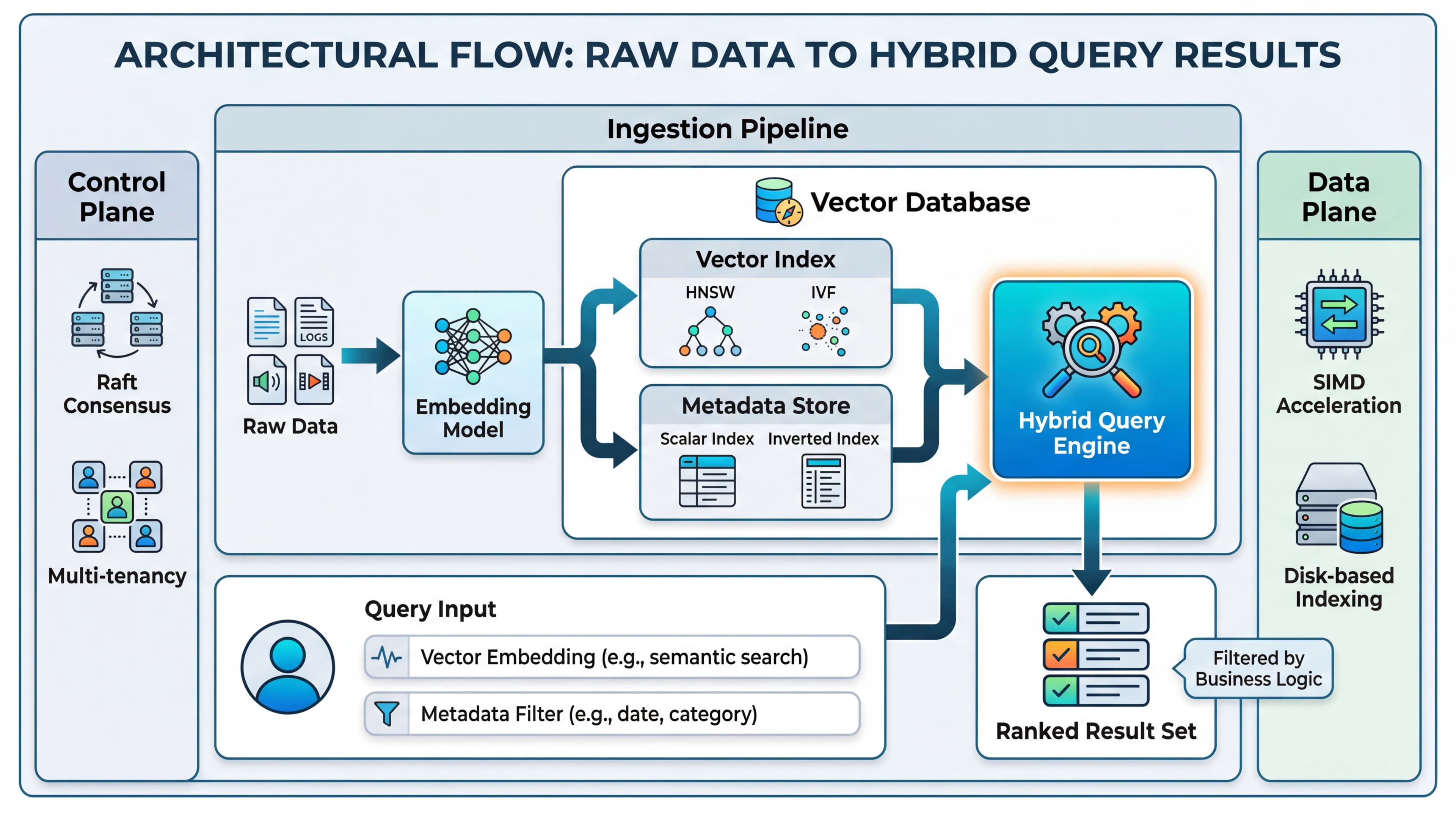 High-Level Vector Database Architecture and Hybrid Search Workflow
Practical Implementations
When implementing a vector strategy, architects must decide between managed services and self-hosted solutions. This decision is often a trade-off between operational velocity and data sovereignty.
Managed & Commercial Options
Managed platforms like Pinecone and Weaviate Cloud are designed for the "AI Engineer" who prioritizes speed-to-market.
- Pinecone has pioneered the serverless model, treating compute as an ephemeral layer. This is ideal for applications with "spiky" traffic patterns.
- Weaviate offers a modular approach, allowing users to plug in vectorization modules (OpenAI, HuggingFace) directly into the database. This turns the database into a full-stack AI platform where the schema itself defines the transformation logic.
Self-Hosted & Open Source
For organizations with strict data residency requirements or petabyte-scale datasets, self-hosted engines like Milvus and Qdrant are the standard.
- Milvus is built on a "log-as-backbone" disaggregated architecture. It is designed for massive, distributed clusters where components like the Query Node, Data Node, and Index Node scale independently.
- Qdrant focuses on performance density. By using Rust and hardware-aware optimizations, it provides ultra-low latency for high-throughput applications, making it a favorite for real-time recommendation engines.
- Chroma serves as the "embedded" entry point, ideal for rapid prototyping where the database lives alongside the application code.
The Role of "A" (Comparing Prompt Variants)
In the practical implementation phase, developers often use A (Comparing prompt variants) to evaluate the quality of the retrieval. By testing different embedding models or prompt structures against the vector database, teams can quantify how changes in the "query vector" affect the relevance of the returned context, a process essential for tuning RAG pipelines.
Advanced Techniques
The true power of a modern vector platform lies in its ability to handle complex, multi-stage queries through Metadata & Filtering.
The Precision-Recall Funnel
Vector search is inherently probabilistic; it finds what is "similar," not necessarily what is "correct." Metadata acts as the deterministic "Control Plane" that bridges this gap.
- Attribute-Based Filtering (ABF): By applying hard constraints (e.g.,
tenant_id == 'A',date > '2023-01-01') before or during the vector search, the system restricts the search space. This ensures that a semantic search for "financial reports" doesn't return data from the wrong year or the wrong client. - Hybrid Search: This technique combines the strengths of BM25 (lexical/keyword search) with vector search (semantic search). A reciprocal rank fusion (RRF) algorithm then merges the results, providing a balanced output that captures both specific terminology and general intent.
Multi-Tenancy and Security
In enterprise environments, Multi-Tenancy: Isolated data per tenant is a non-negotiable requirement. Advanced vector databases implement this through:
- Metadata Isolation: Using a
tenant_idfield in every metadata object and enforcing it at the query level. - Physical Isolation: Creating separate indices or collections for each tenant, which provides the highest level of security but increases operational complexity.
Research and Future Directions
The next frontier for vector databases involves deeper integration with hardware and the convergence of data types.
- Hardware-Aware Indexing: Research is moving toward SIMD-accelerated bitmasking and GPU-accelerated index construction. By offloading the heavy lifting of distance calculations (Euclidean, Cosine, Dot Product) to specialized hardware, P99 latencies can be pushed into the sub-millisecond range even for billion-scale datasets.
- Disk-Based Vector Indices: To solve the "RAM bottleneck," new architectures like DiskANN allow for high-performance search where the majority of the index resides on NVMe SSDs rather than expensive RAM, drastically reducing the Total Cost of Ownership (TCO).
- Raft-Based Consensus: As vector databases become distributed systems, implementing robust consensus algorithms like Raft ensures data consistency across shards, a critical requirement for "Modular Open-Core" platforms like Weaviate.
- LSM-Tree Slab Architectures: Borrowing from traditional NoSQL databases, using Log-Structured Merge-trees for vector storage allows for high-throughput writes and efficient compaction, which is vital for real-time data streams (e.g., social media feeds or sensor data).
Frequently Asked Questions
Q: Why can't I just use a traditional database with a vector plugin (like pgvector)?
While plugins like pgvector for PostgreSQL are excellent for small-to-medium workloads, they often struggle with "The Three S's" at scale. Dedicated Vector Databases are built from the ground up for high-dimensional indexing. They offer specialized features like specialized caching for HNSW graphs, disaggregated compute/storage for cost-efficiency, and native integrations with AI orchestration frameworks (LangChain, LlamaIndex) that traditional DBs lack.
Q: What is the "Recall Gap" in RAG, and how does metadata solve it?
The "Recall Gap" occurs when a vector search returns semantically similar results that are factually irrelevant or prohibited by business logic (e.g., returning a 2022 policy for a 2024 query). Metadata filtering acts as a "hard gate" in the precision-recall funnel, ensuring the search space is restricted to valid records before the probabilistic vector search occurs.
Q: How do "Serverless" vector databases handle the "Cold Start" problem?
Serverless platforms like Pinecone manage cold starts by decoupling the storage of the index (in blob storage) from the compute nodes. When a query arrives, the system dynamically loads the necessary "slabs" of the index into a warm compute cache. While this can introduce slight latency for the first query, the proprietary LSM-tree architectures are optimized to make this transition nearly invisible to the end-user.
Q: Is HNSW always better than IVF for indexing?
Not necessarily. HNSW (Hierarchical Navigable Small World) offers superior query speed and recall but has a high memory footprint and slow index build times. IVF (Inverted File Index) is more memory-efficient and faster to build but can suffer from lower recall if the number of clusters (centroids) isn't tuned correctly. The choice depends on whether your application is read-heavy (HNSW) or write-heavy (IVF).
Q: How does "A" (Comparing prompt variants) impact database performance?
While A (Comparing prompt variants) is primarily a tool for improving LLM output quality, it directly impacts the database by changing the "query vector." Different prompt variants may lead to different embeddings being generated by the model. If a prompt variant results in a "noisy" vector, the database may have to scan more of the index to find relevant matches, potentially increasing latency and reducing precision.