TLDR
Modern Retrieval Systems have transitioned from static document lookups to dynamic, high-dimensional intelligence engines. The core challenge of Retrieval-Augmented Generation (RAG) is the Semantic Gap: the discrepancy between mathematical similarity and generative utility. To bridge this, architects must synchronize Chunking Strategies (data resolution), Embeddings (mathematical representation), and Search Algorithms (retrieval logic) into a unified pipeline. By moving beyond simple EM (Exact Match) toward Hybrid Search and Retriever-Generator Co-Design, systems can achieve higher precision, reduced hallucinations, and operational awareness of structured business constraints.
Conceptual Overview
In the architecture of a technical knowledge engine, the retrieval system is the "sensory organ" of the Large Language Model (LLM). Without a robust retrieval layer, an LLM is limited to its training cutoff and prone to "confabulation" when faced with proprietary or niche data.
The Retrieval Pipeline as a Systems View
A retrieval system is not a single component but a multi-stage pipeline designed to navigate the Dimensionality Paradox. As we move from raw text to actionable context, the system must balance the Curse of Dimensionality (where high-dimensional data becomes sparse and difficult to query) with the need for semantic depth.
- The Resolution Layer (Chunking): Before data can be searched, it must be partitioned. The strategy chosen here determines the "unit of thought" for the retriever.
- The Representation Layer (Embeddings): Text is projected into a Latent Space—a high-dimensional manifold where geometric proximity correlates to conceptual similarity.
- The Traversal Layer (Search Algorithms): This layer manages the "Search Funnel," using efficient indexing to narrow down billions of documents to a handful of candidates.
- The Constraint Layer (Structured Search): This ensures the system respects "hard" data boundaries (e.g., security permissions, timestamps, or versioning) that vector math often ignores.
- The Feedback Layer (Co-Design): The final stage where the retriever and generator are optimized jointly, ensuring the retrieved evidence is actually "useful" for the final output.
The Geometry of Meaning
At the heart of this system lies the transformation of discrete language into continuous mathematical structures. While EM (Exact Match) systems rely on a Trie (prefix tree) or inverted index to find literal strings, semantic systems use vector geometry. In this space, the distance between vectors (Cosine Similarity) represents the relationship between ideas. However, a "perfect" mathematical match does not always equal a "perfect" answer for the LLM, necessitating the advanced techniques discussed below.
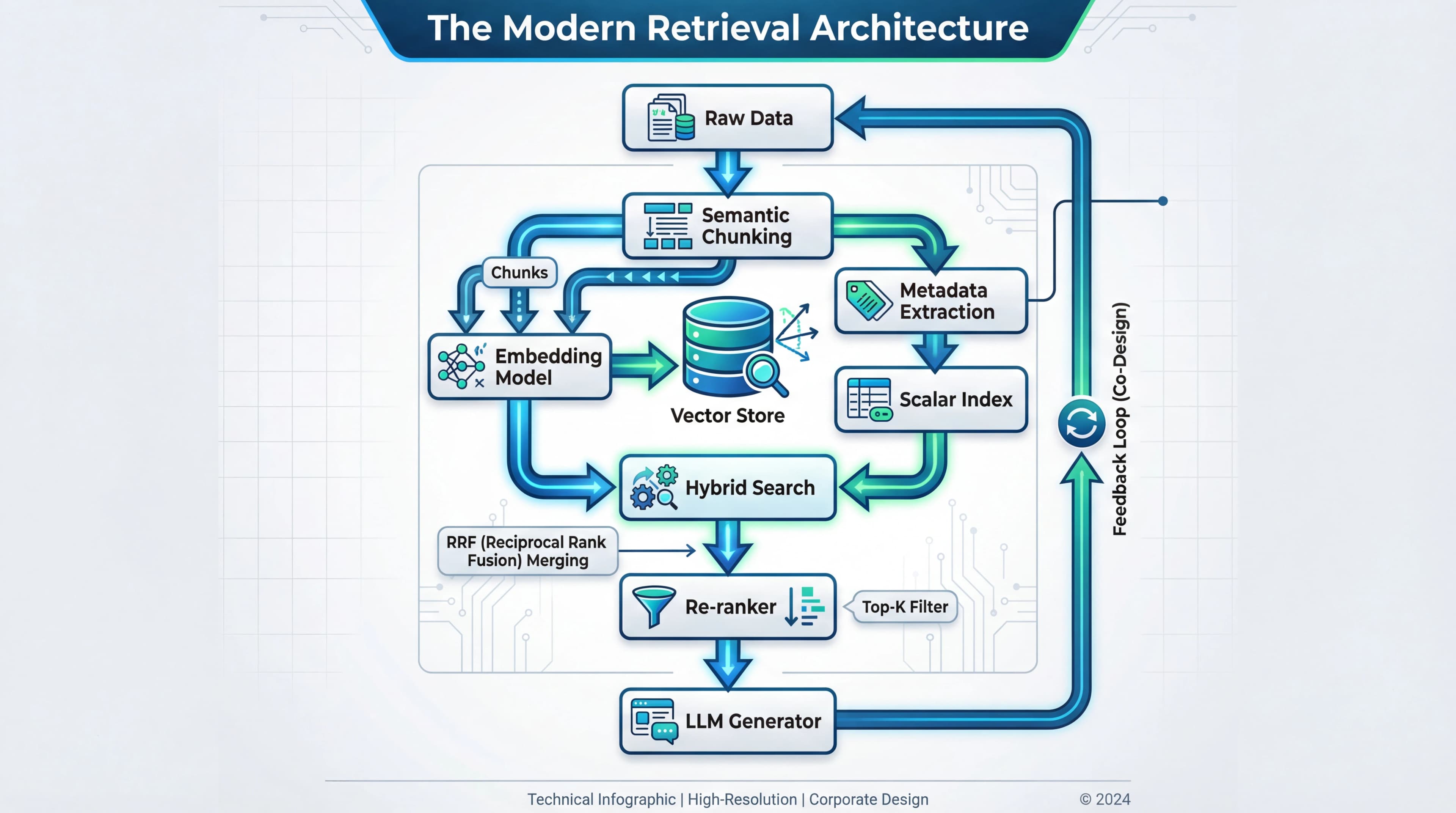 The Modern Retrieval-Augmented Generation (RAG) Architecture
Infographic Description: A vertical funnel representing the data flow. At the top, "Raw Data" enters "Semantic Chunking." The chunks flow into an "Embedding Model," which populates a "Vector Store." Parallel to this, "Metadata" is extracted into a "Scalar Index." A "Hybrid Search" engine sits in the middle, merging results from both indices using RRF. At the bottom, a "Re-ranker" filters the top-K results before passing them to the "LLM Generator," with a feedback loop (Co-Design) returning to the retriever.
The Modern Retrieval-Augmented Generation (RAG) Architecture
Infographic Description: A vertical funnel representing the data flow. At the top, "Raw Data" enters "Semantic Chunking." The chunks flow into an "Embedding Model," which populates a "Vector Store." Parallel to this, "Metadata" is extracted into a "Scalar Index." A "Hybrid Search" engine sits in the middle, merging results from both indices using RRF. At the bottom, a "Re-ranker" filters the top-K results before passing them to the "LLM Generator," with a feedback loop (Co-Design) returning to the retriever.
Practical Implementations
1. Strategic Chunking: Defining the Unit of Retrieval
Chunking is the bridge between raw data and actionable intelligence. The industry has moved through five levels of sophistication:
- Fixed-Size: Splitting by token count. Fast, but breaks sentences in half.
- Recursive/Structural: Respecting Markdown headers or code blocks.
- Semantic Chunking: Using embedding models to detect "topic shifts" between sentences, ensuring each chunk is a coherent concept.
- Late Chunking: A specialized technique where the entire document is passed through a transformer before pooling, allowing individual chunks to "see" the context of the whole document.
2. Embedding Selection and Dimensionality
Choosing an embedding model is a trade-off between latency and "resolution."
- Dense Embeddings: Capture deep semantic meaning but can be computationally expensive.
- Sparse Embeddings: Excellent for technical terms and specific identifiers where EM is required.
- Matryoshka Representation Learning (MRL): A modern approach allowing vectors to be truncated (e.g., from 1536 to 256 dimensions) while retaining most of their accuracy, significantly reducing storage costs.
3. The Search Funnel
To handle massive datasets, we use a tiered approach:
- Recall (Stage 1): Use Approximate Nearest Neighbor (ANN) search or BM25 to find the top 100-1000 candidates.
- Precision (Stage 2): Use a Cross-Encoder or Re-ranker to evaluate the specific relationship between the query and the candidate chunks. This is slower but much more accurate.
Advanced Techniques
Hybrid Search and Reciprocal Rank Fusion (RRF)
The most resilient systems do not choose between keyword and semantic search; they use both. Hybrid Search combines the lexical precision of BM25 with the conceptual reach of vectors. To merge these disparate result sets, architects use RRF, a formula that scores documents based on their rank in each individual search, ensuring that a document appearing in the top 10 of both searches is prioritized over a document that is #1 in only one.
Structured & Semantic Convergence
Pure vector search is "metadata blind." It might retrieve a "v1.0" manual when the user needs "v2.0" because the text is nearly identical. By integrating Metadata Filtering, we apply hard constraints (e.g., WHERE version == '2.0') before or after the vector search. Furthermore, Knowledge Graph Integration allows the system to understand relational links (e.g., "Part A is a component of Machine B"), providing a "Scalar Pillar" of truth to support the "Vector Pillar" of intuition.
Retriever-Generator Co-Design
The "Semantic Gap" occurs when a retriever finds a document that is related to the query but doesn't contain the answer. Co-design solves this by treating the retriever and generator as a single differentiable pipeline. By using the generator's performance as a feedback signal, we can fine-tune the retriever to prioritize "evidence-heavy" chunks over merely "similar" ones.
Research and Future Directions
The frontier of retrieval is moving toward End-to-End Differentiable RAG. In these systems, the retriever is not a static index but a learnable component that adapts to the specific linguistic style of the LLM.
Another area of intense research is the Isomorphism Hypothesis, which suggests that the latent spaces of different languages share a similar geometric structure. This allows for "Zero-Shot Cross-Lingual Retrieval," where a query in English can accurately retrieve documents in Japanese without explicit translation, simply by aligning their vector manifolds.
Finally, the use of A (Comparing prompt variants) is becoming automated. Systems are now being designed to automatically test multiple retrieval-augmented prompt variants to determine which "context window" configuration yields the highest factual density and lowest hallucination rate.
Frequently Asked Questions
Q: Why should I use Semantic Chunking instead of simple fixed-size overlaps?
Fixed-size chunking often severs the relationship between a subject and its predicate, leading to "context fragmentation." Semantic chunking uses the embedding model itself to identify "breakpoints" where the cosine similarity between sentence $N$ and $N+1$ drops significantly. This ensures that each chunk is a self-contained semantic unit, which reduces the noise the LLM has to filter out during generation.
Q: How does a Trie-based approach complement modern Vector Search?
While Vector Search is great for "vibes" and synonyms, it struggles with exact technical identifiers (like a specific UUID or part number). A Trie (prefix tree) or an inverted index provides EM (Exact Match) capabilities. In a hybrid system, the Trie-based search ensures that if a user types an exact error code, that specific documentation is retrieved, even if the "semantic" meaning of the error code is opaque to the embedding model.
Q: What is the "Curse of Dimensionality" in the context of Embeddings?
As you increase the dimensions of an embedding (e.g., from 768 to 3072), the "volume" of the space increases exponentially. Counter-intuitively, this makes all points seem almost equidistant from each other, making similarity measures like Euclidean distance less effective. Modern techniques like Matryoshka Representation Learning (MRL) help mitigate this by packing the most important information into the first few dimensions.
Q: When is Retriever-Generator Co-Design necessary?
Co-design is necessary when your domain requires high "factual density" that standard RAG cannot provide. For example, in legal or medical applications, a standard retriever might find a relevant case study, but the generator might need a specific clause. Co-design trains the retriever to recognize what "useful evidence" looks like for that specific generator, rather than just what "similar text" looks like.
Q: How do I evaluate the effectiveness of my retrieval pipeline?
Evaluation should be split into two phases: Retrieval Evaluation (using metrics like Hit Rate or Mean Reciprocal Rank) and End-to-End Evaluation. The latter often involves A (Comparing prompt variants), where you test how different top-K retrieval settings or chunking sizes affect the LLM's final answer accuracy, often using a "Judge LLM" to score the outputs for factual consistency.