TLDR
In the 2025 landscape, Production & Deployment is no longer a final step but a continuous systems-engineering challenge. It represents the convergence of three critical domains: Infrastructure (the physical/virtual substrate), Optimization (the efficiency of the workload), and Security & Compliance (the integrity of the system). Moving a system to production requires transitioning from "capability" (proving it works) to "viability" (ensuring it is cost-effective, low-latency, and legally compliant). Success is measured by the ability to navigate the Memory Wall, maximize Information Density, and enforce Zero Trust without degrading the user experience.
Conceptual Overview
To architect a production-grade system, one must view these components as a Production Triad. Each pillar exerts pressure on the others, creating a feedback loop that determines the system's ultimate performance.
- Infrastructure (The Ceiling): Defines the theoretical limits of the system. Using the Roofline Model, architects must understand if their workload is compute-bound or memory-bound. In modern AI, the "Memory Wall" often dictates that infrastructure must prioritize interconnect speed over raw FLOPS.
- Optimization (The Engine): Operates within the limits set by infrastructure. It focuses on the Optimization Flywheel, where reducing token bloat and improving retrieval quality directly lowers operational costs and latency.
- Security & Compliance (The Guardrails): Ensures that the engine operates within legal and ethical boundaries. Through Compliance as Code, security is baked into the infrastructure rather than added as a reactive layer.
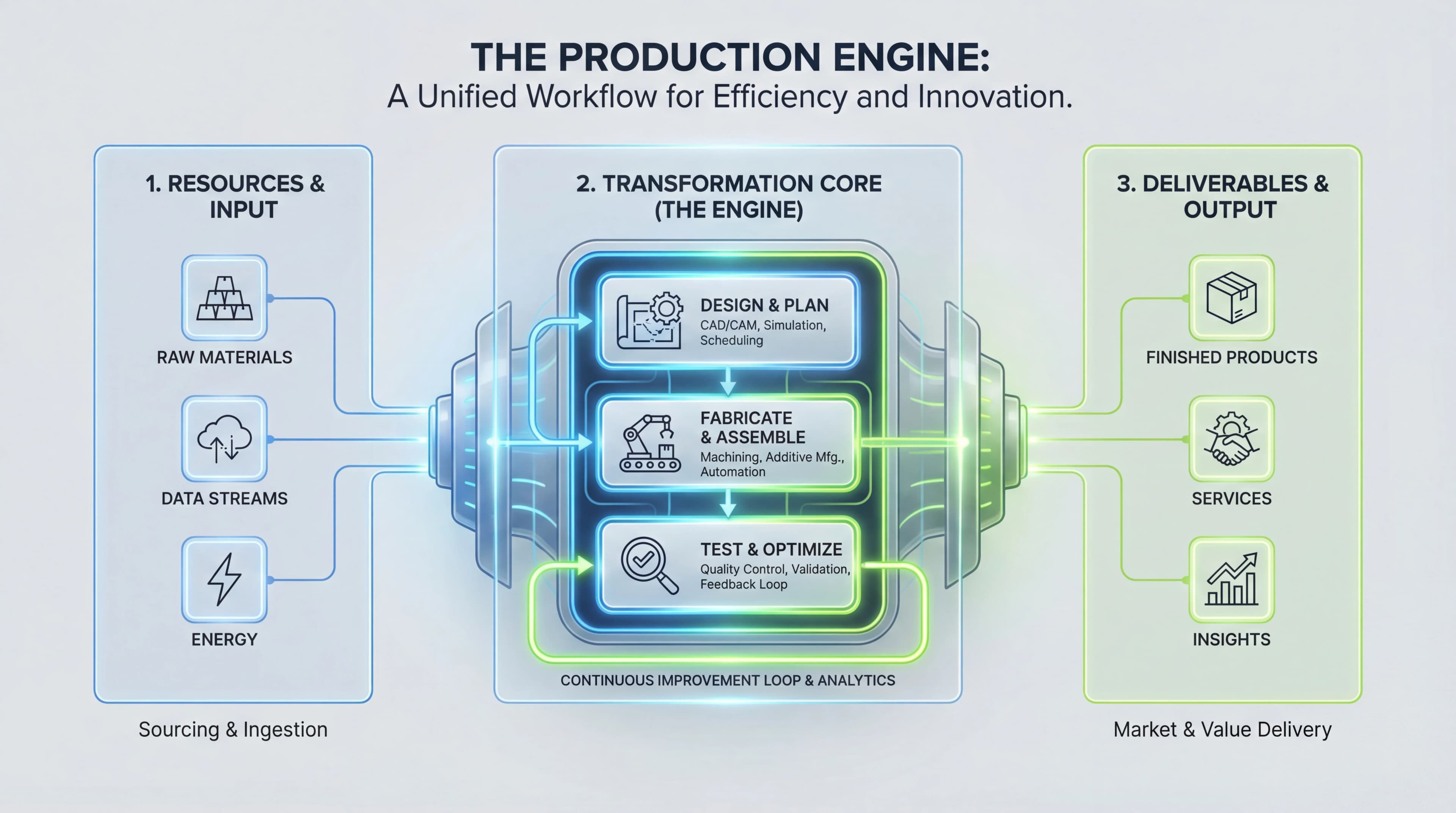 The Production Engine: End-to-End Operational Framework, the left side is 'Optimization' (Efficiency/Cost/Latency), and the right side is 'Security & Compliance' (Zero Trust/Privacy/Safety). At the center is 'Production Viability'. Arrows show the flow: Infrastructure enables Optimization, Security protects Infrastructure, and Optimization funds Security.")
Practical Implementations
Bridging these domains requires a shift toward Unified Operations:
- FinOps & Resource Allocation: Infrastructure costs are managed through the lens of Optimization. By monitoring Arithmetic Intensity, teams can choose the most cost-effective hardware (e.g., Spot instances vs. Reserved) for specific token-processing tasks.
- DevSecOps Pipelines: Security is integrated into the deployment lifecycle. Automated vulnerability scanning and Zero Trust identity management are applied to the infrastructure layer, ensuring that every data packet in the storage trilemma is encrypted and authorized.
- Observability: Modern production requires a "Single Pane of Glass" that tracks hardware health (Infrastructure), P99 latency (Optimization), and threat anomalies (Security) simultaneously.
Advanced Techniques
- Roofline-Aware Scaling: Instead of scaling based on CPU usage, advanced systems scale based on the relationship between memory bandwidth and compute throughput, ensuring that horizontal scaling actually solves the bottleneck.
- Semantic Compression: To optimize costs, systems implement multi-stage retrieval where context is compressed before being sent to the LLM, reducing the "compliance tax" of processing large volumes of sensitive data.
- Automated Red-Teaming: Integrating AI-driven security testing into the CI/CD pipeline to detect prompt injection or data leakage before code reaches the production infrastructure.
Research and Future Directions
The future of production lies in Autonomous Systems. We are moving toward "Shared-Nothing" architectures that can self-optimize based on real-time traffic patterns. Research is currently focused on Hardware-Software Co-design, where the infrastructure is specifically tailored to the optimization algorithms of the model (e.g., custom silicon for specific retrieval patterns). Additionally, the EU AI Act is driving the development of "Self-Auditing" systems that provide real-time compliance telemetry.
Frequently Asked Questions
Q: How does optimization affect security?
Optimization often involves reducing data (e.g., token compression or filtering). While this improves latency, it can inadvertently strip away security metadata or context needed for compliance auditing. A balanced approach ensures that "Information Density" does not come at the cost of "Auditability."
Q: Why is the "Memory Wall" a production concern?
In development, you might run a model on a single high-end GPU. In production, the bottleneck is rarely the processor's speed but the speed at which data moves between nodes. If your infrastructure's interconnect is slow, no amount of software optimization can reduce your P99 latency.
Q: Can I achieve 100% compliance without sacrificing performance?
Through Compliance as Code (CaC), many regulatory checks can be automated and offloaded to the infrastructure layer (e.g., at the API Gateway). This minimizes the "latency tax" typically associated with manual security reviews, allowing for high-velocity deployments.