TLDR
In the context of Retrieval-Augmented Generation (RAG), the ETL (Extract, Transform, Load) pipeline is no longer a background utility—it is the primary determinant of model performance. Modern ingestion architectures have shifted from simple data movement to Document Intelligence, where the goal is to reconstruct the semantic hierarchy of unstructured data. This process involves four critical stages: Extraction (bridging the semantic gap), Transformation (increasing the signal-to-noise ratio), Metadata Enrichment (turning strings into things), and Storage (managing high-dimensional vectors and metadata). By utilizing A (Comparing prompt variants) at each stage, engineers can optimize the pipeline to ensure that the data served to the LLM is accurate, contextualized, and verifiable.
Conceptual Overview
The ingestion pipeline for RAG functions as a "Knowledge Refinery." Raw data—whether it resides in chaotic PDFs, legacy databases, or the dynamic web—is characterized by high entropy. The objective of the ETL process is to systematically reduce this entropy, transforming raw characters into a high-fidelity knowledge base.
The Entropy-to-Intelligence Pipeline
A systems-level view of this process reveals a sequential increase in data value:
- Extraction (The Ingress): Translating visual and physical structures into machine-readable formats (Markdown/JSON).
- Transformation (The Refinery): Normalizing, cleaning, and deduplicating data to ensure a high Signal-to-Noise Ratio (SNR).
- Enrichment (The Contextualizer): Adding layers of metadata (temporal, categorical, and relational) to provide the "who, what, and when."
- Storage (The Persistence): Organizing data into multi-tiered architectures that support both semantic proximity and exact-match filtering.
The Role of "A" in Pipeline Optimization
A critical innovation in modern ingestion is the use of A (Comparing prompt variants). Because many stages of the pipeline—such as VLM-based extraction or semantic tagging—rely on LLMs, the logic is no longer deterministic. Engineers must treat extraction and enrichment prompts as hyperparameters, using A to validate which prompt structure yields the highest retrieval accuracy in downstream RAG tasks.
Infographic: The Modern RAG Ingestion Architecture
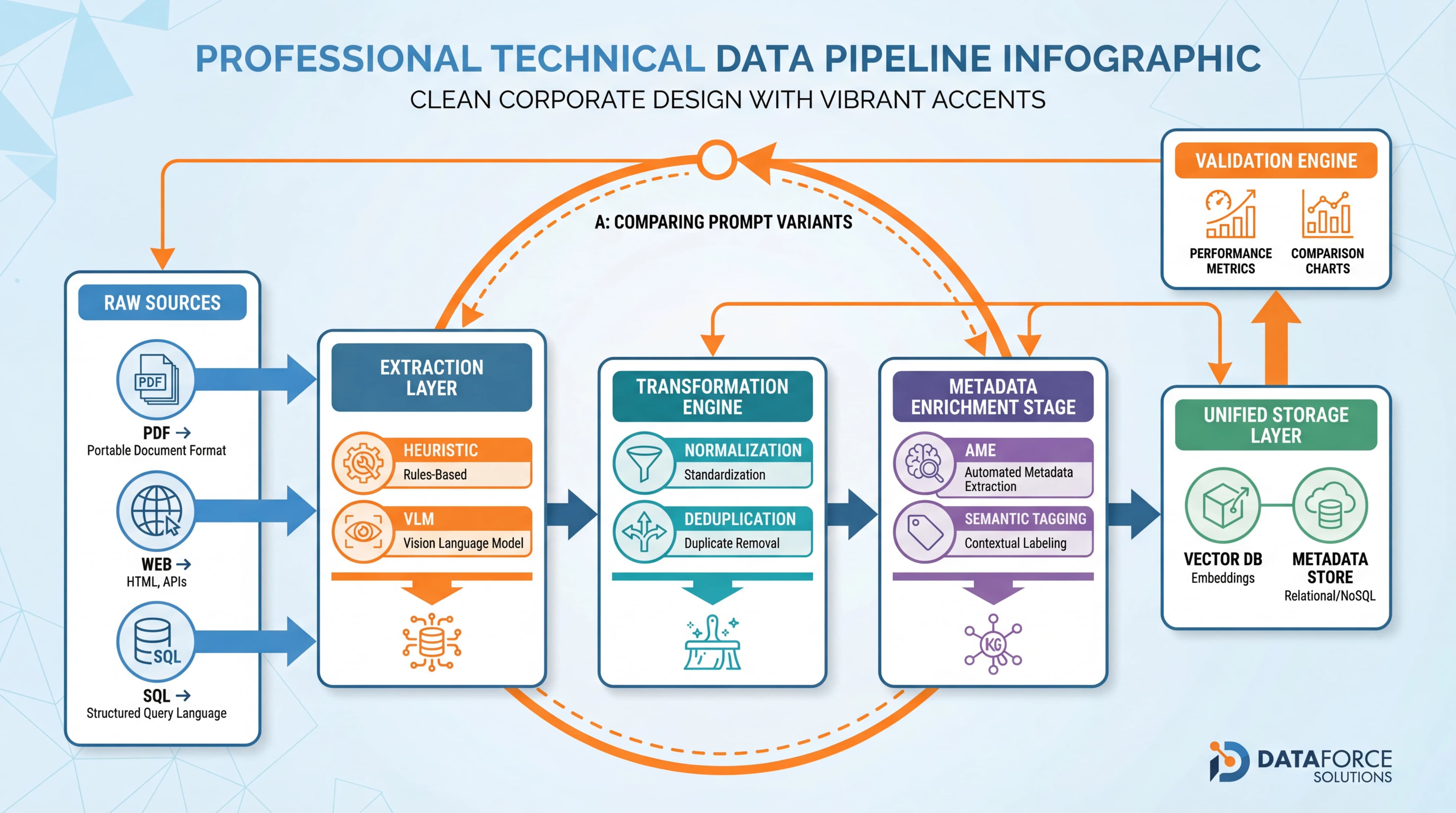 The Agentic RAG Data Orchestration and Validation Ecosystem
Practical Implementations
Building a production-grade ingestion pipeline requires a modular approach where each component is optimized for its specific role while remaining aware of the requirements of the next stage.
1. High-Fidelity Extraction
The "Semantic Gap" is the primary enemy of extraction. When a PDF is flattened into text, the visual hierarchy (headers, columns, tables) is lost.
- Heuristic Parsers: Use these for digital-native documents with predictable schemas (e.g., standardized invoices).
- Vision-Language Models (VLMs): Use models like GPT-4o or specialized layout models for complex, multi-column, or "noisy" documents. The goal is to output Markdown, which preserves structural cues that LLMs can easily interpret.
2. Neural Transformation & Cleaning
Traditional cleaning relied on Regex. Modern ETL uses Hybrid Neural Architectures.
- Normalization: Collapsing variations (e.g., "U.S.A." vs "United States") into canonical forms.
- Deduplication: This is vital for RAG. If the same information exists in five different chunks, the retriever will waste context window space on redundant data. Semantic deduplication identifies near-identical content even if the wording differs.
3. Metadata Enrichment: "Strings to Things"
Enrichment transforms a "data graveyard" into a searchable knowledge graph.
- Automatic Metadata Extraction (AME): Identifying document properties (author, date, version) automatically.
- Semantic Tagging: Linking entities in the text to a central taxonomy. For example, tagging "The Fed" as "Federal Reserve" allows for more robust filtering during retrieval.
4. Multi-Tiered Storage
The "Great Convergence" of storage means we no longer separate vectors from metadata.
- Vector Formats: Using formats like Lance or DiskANN to allow for high-speed semantic search.
- Metadata Filtering: Ensuring that the storage layer supports "Pre-filtering" (e.g., "Find all chunks related to 'Project X' from '2023'"). This significantly reduces the search space and improves accuracy.
Advanced Techniques
VLM-Driven Document Intelligence
Instead of OCR followed by text parsing, advanced pipelines use VLMs to "see" the document. This allows the system to understand the relationship between a caption and an image, or the nested structure of a complex financial table. By using A (Comparing prompt variants), teams can determine if a "Chain-of-Thought" prompt improves table extraction accuracy over a simple "Extract JSON" prompt.
Privacy-Preserving Ingestion
In regulated industries, the transformation stage must include Privacy Anonymization. This involves identifying PII (Personally Identifiable Information) and replacing it with synthetic tokens before the data ever hits the vector database. This prevents "Mosaic Attacks," where an attacker reconstructs sensitive data through multiple RAG queries.
Dynamic Chunking Strategies
Rather than fixed-size chunks (e.g., 500 tokens), advanced pipelines use Semantic Chunking. This technique monitors the "semantic drift" between sentences; when the topic changes significantly, a new chunk is created. This ensures that each chunk contains a coherent concept, maximizing the effectiveness of the embedding.
Research and Future Directions
Multimodal Latent Spaces
The future of ingestion is not just text. We are moving toward pipelines that ingest images, audio, and video into a Unified Latent Space. In this model, a video clip and its transcript are stored as related vectors, allowing a RAG system to retrieve visual evidence for a textual claim.
Self-Healing Pipelines
Research is currently focused on "Self-Healing" ETL. If a retrieval failure occurs in the RAG system, an agentic loop analyzes whether the failure was due to poor extraction or missing metadata. The system then re-processes the source document with a different prompt variant (optimized via A) to correct the error autonomously.
Real-Time Ingestion (Streaming RAG)
The latency between data creation and availability in the vector store is shrinking. Streaming ETL architectures (using tools like Kafka or Flink) are being adapted for RAG, allowing models to reason over data that was generated only seconds prior.
Frequently Asked Questions
Q: How does extraction quality directly impact vector quantization?
Extraction quality determines the "purity" of the input string. If the extraction includes "noise" (e.g., page numbers, running headers, or garbled OCR), the resulting embedding vector will be shifted in the latent space. When you apply quantization (compressing vectors to save space), this noise is amplified, leading to a significant drop in retrieval precision. High-fidelity extraction is the best defense against quantization loss.
Q: Why is deduplication more critical for RAG than for traditional search?
In traditional search, seeing the same result twice is a minor UI annoyance. In RAG, the LLM has a limited context window. If the top 5 retrieved chunks are all near-duplicates of the same information, you have effectively wasted 80% of the model's "memory," preventing it from seeing other relevant perspectives or data points needed to synthesize a complete answer.
Q: How do I use "A" (Comparing prompt variants) to optimize my metadata enrichment?
You should create a "Golden Dataset" of documents with manually verified metadata. Then, run your enrichment pipeline using different prompt variants (e.g., "Extract entities" vs. "Extract entities and link them to our CRM"). By comparing the F1-score of the extracted metadata against your Golden Dataset, you can scientifically determine which prompt variant produces the most reliable enrichment.
Q: What is the "Object-Relational Impedance Mismatch" in the context of AI storage?
This refers to the difficulty of mapping the hierarchical, high-dimensional nature of AI data (nested JSON, vectors, and relationships) into the flat, row-based structure of traditional SQL databases. Modern storage formats like Lance solve this by being "column-aware" and treating vectors as first-class citizens, allowing for complex nested queries without the performance hit of traditional joins.
Q: Can Metadata Enrichment help mitigate LLM hallucinations?
Yes, significantly. By enriching chunks with Source Attribution and Temporal Metadata, the RAG system can provide the LLM with explicit instructions: "Only answer using documents from 2024" or "Cite the specific page number provided in the metadata." This forces the model to ground its response in the provided context, reducing the likelihood of it "inventing" facts.