TLDR
Modern RAG (Retrieval-Augmented Generation) has evolved from a simple "search-and-summarize" script into a sophisticated architectural stack. This overview synthesizes the transition from Basic RAG Flows—which establish the foundational dual-pipeline of ingestion and inference—to Advanced RAG Patterns that introduce self-correction and multi-query expansion. We further explore the "Agentic Shift," where Large Language Models (LLMs) act as autonomous orchestrators using Agentic & Dynamic Strategies to navigate complex toolsets. Finally, we examine Pipeline Extensions, the operational layer that provides the memory, real-time data freshness, and federated access required for enterprise-grade deployments. By moving from linear pipelines to stateful reasoning graphs, architects can overcome the limitations of "Naive RAG," such as hallucinations, retrieval noise, and data staleness.
Conceptual Overview
To understand the current state of RAG, one must view it through the lens of a Maturity Model. The system is no longer a monolithic process but a modular orchestration of four distinct layers:
- The Foundational Layer (Basic Flows): This is the "Open Book" phase. It focuses on the mechanics of decoupling knowledge from model parameters. It introduces the standard retrieval-generation flow and solves simple multi-hop problems through query decomposition.
- The Logic Layer (Advanced Patterns): This layer introduces "Skepticism." Instead of blindly trusting the retriever, the system uses techniques like A (Comparing prompt variants) to expand search perspectives and employs evaluators (CRAG) to verify the relevance of retrieved documents before they reach the generator.
- The Autonomy Layer (Agentic Strategies): Here, the pipeline becomes a Stateful Graph. The LLM is no longer a passive recipient of data but an active agent that decides if it needs to search, which tools to use, and when to stop. This introduces the "Agent Tax"—higher latency and cost—in exchange for solving ambiguous, high-stakes queries.
- The Operational Layer (Pipeline Extensions): This layer addresses the "Real World" constraints. It provides the infrastructure for Memory (long-term context), Streaming (real-time updates via Kafka/CDC), and Federation (querying siloed data without centralization).
The Systems View: From Pipeline to Graph
In a traditional pipeline, data flows in one direction. In a modern RAG system, the flow is iterative and conditional.
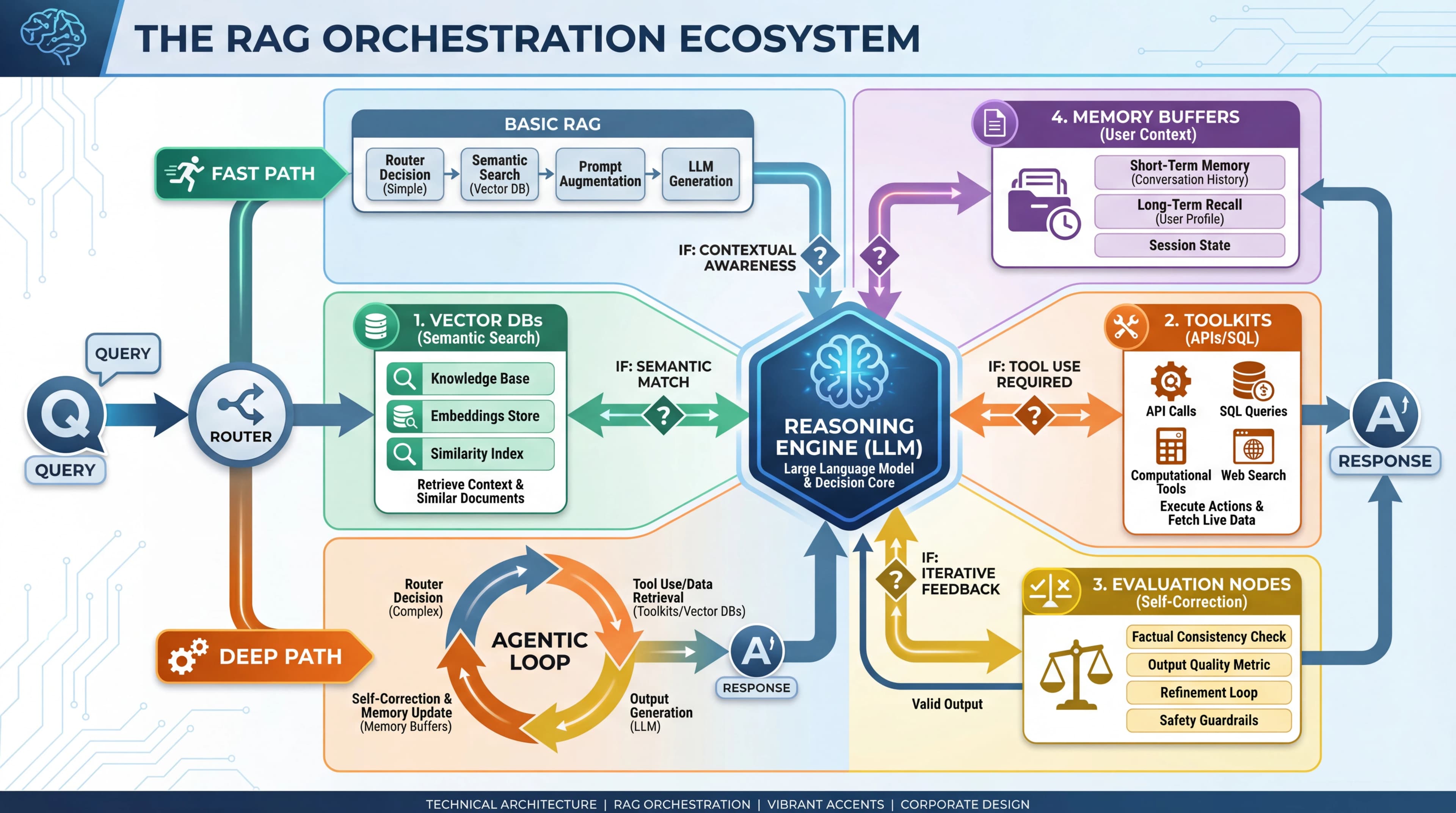 The RAG Orchestration Ecosystem: Agentic AI Workflow Diagram
Practical Implementations
Implementing a production-grade RAG system requires balancing the simplicity of basic flows with the robustness of advanced patterns.
1. Establishing the Foundation
The first step is the Standard Retrieval-Generation Flow. This involves an offline ingestion pipeline (chunking, embedding, and indexing using structures like Trie for metadata) and an online inference pipeline. To improve initial retrieval, developers often use A (Comparing prompt variants) to determine which phrasing yields the highest hit rate in the vector database.
2. Introducing the Reasoning Loop
As complexity grows, "Naive RAG" fails due to retrieval noise. Practical implementation shifts toward Multi-Query RAG. By generating multiple versions of a user's prompt, the system can capture different semantic facets of the same intent, effectively overcoming the "vocabulary mismatch" problem where the user's words don't perfectly align with the document's text.
3. Transitioning to Agentic Graphs
For enterprise applications involving multiple data sources (e.g., a CRM, a technical wiki, and a live SQL database), a linear pipeline is insufficient. Implementation involves:
- Routing: A lightweight LLM call to decide which "tool" or "path" to take.
- Tool-Based RAG: Providing the LLM with function definitions that allow it to query specific APIs.
- State Management: Using frameworks like LangGraph or AutoGen to maintain the "state" of the conversation and the gathered facts across multiple loops.
Advanced Techniques
Beyond simple retrieval, several high-order patterns have emerged to ensure groundedness and precision.
Self-Correction and Reflection
Self-RAG and Corrective RAG (CRAG) are the gold standards for reliability. In these patterns, the system retrieves documents and then performs a "Quality Gate" check. If the documents are deemed "Ambiguous" or "Incorrect," the system triggers a secondary search (perhaps using a broader web search) or asks the user for clarification. This "Reflexion" allows the model to critique its own proposed answer against the retrieved context before the user ever sees it.
Federated and Real-Time Extensions
In highly regulated industries, data cannot always be centralized. Federated RAG allows the reasoning engine to dispatch sub-queries to distributed nodes, aggregating the results locally. Simultaneously, to prevent the "Staleness Gap," Streaming RAG utilizes Change Data Capture (CDC) to update vector indices the moment a source document is edited, ensuring the LLM always has access to the "Ground Truth" of the present moment.
Research and Future Directions
The frontier of RAG is currently focused on three primary challenges:
- The Agent Tax Mitigation: Researchers are looking for ways to reduce the latency of agentic loops. This includes using "Small Language Models" (SLMs) as specialized routers and evaluators, reserving the "Large" models only for the final synthesis.
- Long-Context vs. RAG: With models supporting 1M+ token context windows, the debate continues: do we need retrieval if we can fit the whole library in the prompt? The consensus is shifting toward a hybrid approach where RAG acts as a "pre-filter" to keep costs down and focus the model's attention.
- Recursive Query Trees: Moving beyond flat semantic search, future systems will likely use hierarchical indexing. By summarizing large document clusters into "Query Trees," the system can perform a top-down search, identifying the correct "neighborhood" of knowledge before diving into specific chunks.
Frequently Asked Questions
Q: How does 'A' (Comparing prompt variants) actually improve retrieval performance?
A allows developers to identify the "semantic sensitivity" of their vector database. By generating 3-5 variations of a user's query and analyzing the overlap in retrieved documents, the system can either pick the most "stable" results or use a reciprocal rank fusion (RRF) algorithm to combine the results of all variants, significantly reducing the chance of missing a key document due to poor phrasing.
Q: When should I choose Agentic RAG over Advanced RAG?
The choice depends on the Uncertainty and Tool Requirement of the task. Use Advanced RAG (like CRAG) if you have a single data source but need high factuality. Use Agentic RAG if the answer requires multiple steps (e.g., "Check the inventory in SQL, then find the shipping policy in the PDF, and draft an email") where the LLM must plan and execute a sequence of actions.
Q: What is the 'Agent Tax' and how can it be managed?
The "Agent Tax" refers to the cumulative latency and token cost incurred by multiple LLM calls in a reasoning loop. It can be managed by:
- Prompt Caching: Reusing context for iterative loops.
- Model Tiering: Using a fast, cheap model (like GPT-4o-mini) for routing and a powerful model (like Claude 3.5 Sonnet) for final generation.
- Early Exit: Allowing the agent to stop as soon as a "confidence threshold" is met.
Q: How does Federated RAG handle data privacy?
In a Federated RAG setup, the raw data never leaves its original silo. The central orchestrator sends a "search request" to the silo's local retriever. The silo returns only the relevant text chunks (or even just a summary). This ensures that the central model only sees the specific information needed for the query, rather than having full access to the entire sensitive dataset.
Q: Can RAG pipelines handle real-time data like stock prices or live sensor feeds?
Yes, through Streaming Pipeline Extensions. By integrating with event-streaming platforms like Kafka, the RAG system can trigger an "Index Update" every time a data point changes. For extremely high-frequency data, the system often bypasses the vector DB entirely, using a "Tool-Based" approach to query a live API or a time-series database directly during the retrieval step.
References
- Lewis et al. (2020) Retrieval-Augmented Generation
- Self-RAG: Learning to Retrieve, Generate, and Critique
- Corrective RAG (CRAG) Framework