TLDR
The landscape of artificial intelligence is undergoing a fundamental phase shift: the transition from Chatbots to AI Agents. While a Chatbot is a conversational interface designed for reactive information retrieval, an AI Agent is an autonomous system that utilizes Large Language Models (LLMs) as a reasoning engine to plan and execute multi-step workflows. This evolution is characterized by the move from "System 1" (intuitive, next-token prediction) to "System 2" (deliberative, self-correcting) processing. Success in this domain requires mastering the "Agentic Stack"—a four-layer architecture comprising Orchestration, Runtime, Memory, and Governance—to achieve Aligned Autonomy, where agents solve complex problems while remaining strictly bounded by human intent.
Conceptual Overview
To navigate the world of AI agents, one must adopt a Systems View. We no longer view the LLM as a standalone product, but as the "Brain" within a larger organism. This organism operates within a Perception-Action Loop: it perceives its environment (via NLU and multimodal inputs), reasons about its state (via cognitive architectures), and executes actions (via tool use and APIs) to achieve a goal.
The Spectrum of Autonomy
The relationship between chatbots and agents is best understood as a spectrum rather than a binary.
- Level 1: Reactive Chatbots: Primarily focused on intent classification and slot filling. They inhabit a "closed" reality.
- Level 2: RAG-Enabled Assistants: Use external data to ground responses but remain linear in their execution.
- Level 3: Tool-Use Agents: Can select and execute external functions (e.g., "Check the weather") but lack long-term planning.
- Level 4: Autonomous Agents: Capable of decomposing complex goals, self-correcting, and managing persistent state across long horizons.
The Agentic Stack Architecture
The modern agentic ecosystem is built upon a four-layer stack:
- The Orchestration Layer: Frameworks like LangGraph and CrewAI that manage the "logic" of the agentic loop.
- The Runtime Layer: Managed Agent Platforms (MAPs) that provide the enterprise-grade environment for execution, security, and scaling.
- The Memory Layer: A tripartite structure consisting of Working Memory (context window), Episodic Memory (past interactions), and Semantic Memory (RAG-driven knowledge).
- The Governance Layer: The "Control Plane" that manages the "Iron Triangle" of cost, latency, and quality, ensuring the system avoids failure modes like "Runaway Agents."
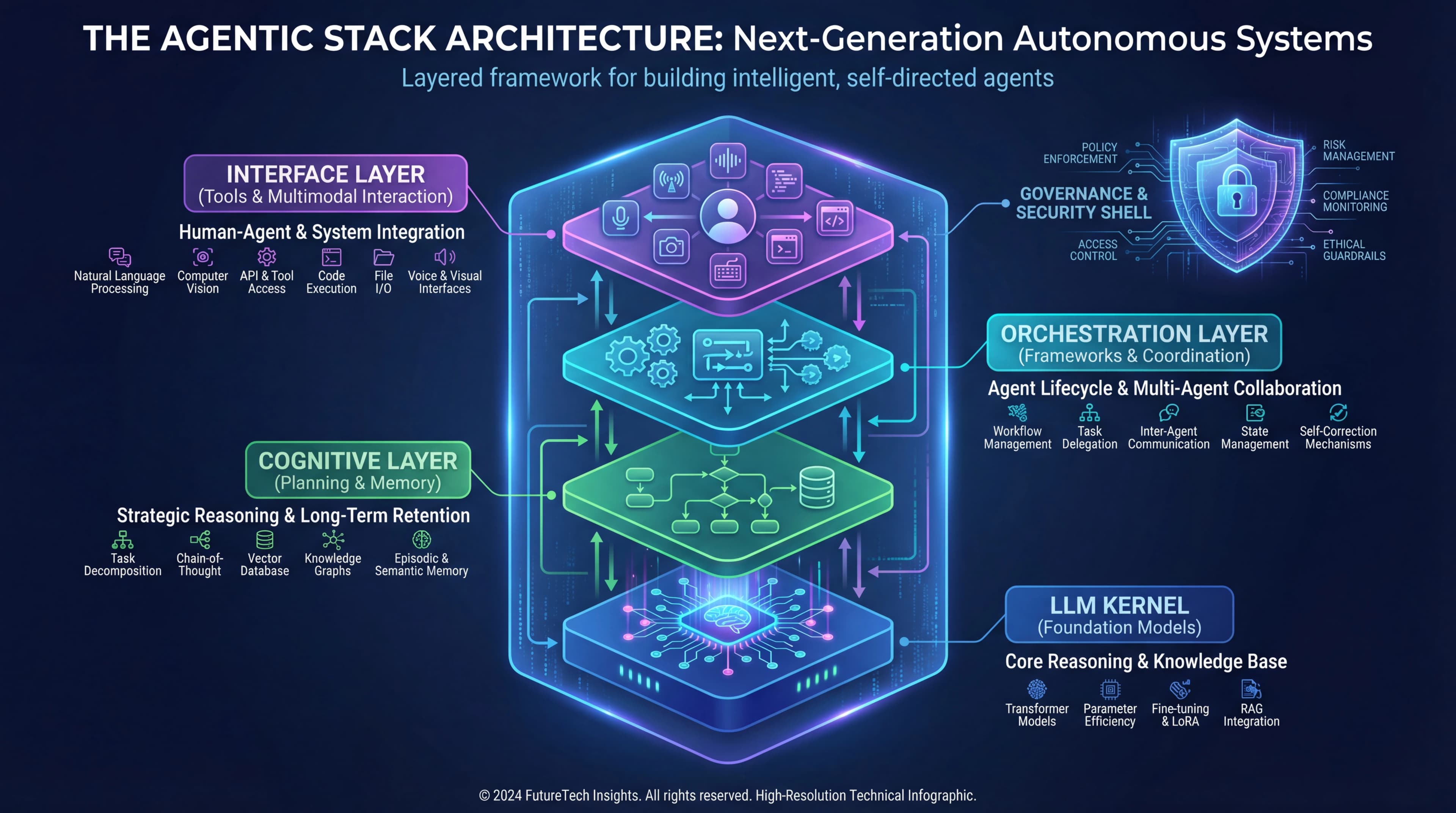 The Agentic Stack Architecture Overview
Diagram Description: A vertical stack showing the LLM Kernel at the base, topped by the Cognitive Layer (Planning/Memory), the Orchestration Layer (Frameworks), and the Interface Layer (Tools/Multimodal), all wrapped in a Governance & Security shell.
The Agentic Stack Architecture Overview
Diagram Description: A vertical stack showing the LLM Kernel at the base, topped by the Cognitive Layer (Planning/Memory), the Orchestration Layer (Frameworks), and the Interface Layer (Tools/Multimodal), all wrapped in a Governance & Security shell.
Practical Implementations
Transitioning from theory to production requires moving beyond "Naive RAG" toward Agentic RAG and structured design patterns.
From Naive to Agentic RAG
Traditional Retrieval-Augmented Generation is a "one-shot" process: Query → Retrieve → Generate. This often fails due to low precision or "lost in the middle" context issues. Agentic RAG transforms retrieval into a tool-use problem. The agent doesn't just retrieve; it evaluates the quality of the retrieved documents, reformulates the query if the results are poor, and iterates until it has sufficient information to answer.
Core Design Patterns
Architects typically deploy one of two primary patterns:
- Single-Agent (Router) Pattern: A central LLM acts as a dispatcher, selecting tools from a toolbox defined via JSON schemas. This is ideal for task-specific automation.
- Multi-Agent Coordination: Complex tasks are decomposed by a "Manager Agent" and delegated to specialized "Worker Agents" (e.g., a Researcher Agent, a Coder Agent, and a Reviewer Agent). This mimics organizational structures and reduces the cognitive load on any single model instance.
The Deployment Playbook
Enterprise deployment follows the OODA Loop (Observe, Orient, Decide, Act). Organizations are moving toward a "Human-in-the-loop" model where agents handle the 80% of routine tasks, escalating only the most complex or high-risk edge cases to human operators. This requires rigorous evaluation, often involving A: Comparing prompt variants, to ensure the non-deterministic nature of agents remains within operational bounds.
Advanced Techniques
The "intelligence" of an agent is determined by its Cognitive Architecture—the strategies it uses to move from System 1 to System 2 thinking.
Reasoning Strategies
- Chain-of-Thought (CoT): Forcing the model to "show its work" in a linear sequence.
- Tree of Thoughts (ToT): Allowing the model to branch into multiple potential solutions, evaluate them, and backtrack from dead ends using search algorithms like BFS or MCTS.
- ReAct (Reason + Act): A framework where the model interleaves reasoning traces and action execution, allowing it to update its plan based on real-world feedback.
- Reflexion: An iterative pattern where the agent critiques its own previous output to correct errors before finalizing a response.
The Trust Stack and SRE Principles
Operating agents at scale introduces unique risks. The Agentic Control Plane must implement:
- Rate Limiting & Token Budgeting: To prevent "Runaway Agents" from incurring massive costs.
- Policy-as-Code: Moving beyond brittle system prompts to enforceable rules that govern tool usage and data access.
- Observability: Tracking the "trace" of an agent's reasoning to debug why a specific action was taken.
Research and Future Directions
The future of agents lies in the transition from application-level tools to system-level kernels.
The AI Operating System (AIOS)
In the AIOS paradigm, the LLM is the Kernel. Just as a traditional OS manages hardware resources (CPU/RAM), the AIOS manages semantic resources. It handles context window "paging," schedules agent tasks, and manages the "Memory Wall"—the bottleneck created by the limited context window of current models.
Persistent Memory as a Moat
As agents interact with users over months and years, they accumulate Persistent Memory. This creates a competitive moat; an agent that remembers your preferences, past projects, and organizational nuances is far more valuable than a "fresh" model. This requires moving from stateless interactions to stateful architectures where memory is tiered across vector databases and long-term graph structures.
Human-Agent Co-evolution
We are entering an era of recursive feedback loops. As agents become more capable, human behavior will adapt to leverage them, which in turn provides new data for agents to learn from. This co-evolution will eventually lead to distributed intelligence networks where the boundary between human intent and machine execution becomes increasingly fluid.
Frequently Asked Questions
Q: What is the "Memory Wall," and how do agents overcome it?
The "Memory Wall" refers to the physical and computational limits of the LLM's context window. Even with "infinite" context models, performance degrades as the window fills. Agents overcome this using Tripartite Memory: keeping only the most relevant "Working Memory" in the prompt, while offloading "Episodic" (past events) and "Semantic" (facts) data to external vector databases, retrieving them only when needed via RAG.
Q: How does Agentic RAG differ from standard RAG?
Standard RAG is a linear, one-way street. Agentic RAG is a loop. An agentic RAG system can look at the search results, realize they are irrelevant, and try a different search query or look in a different database. It introduces a "critique" step where the agent evaluates its own context before generating an answer.
Q: What are "Runaway Agents," and how can they be prevented?
A Runaway Agent is an autonomous system that enters an infinite loop of tool calls or reasoning steps, often due to a logic error or an ambiguous goal. This can lead to massive API costs or system instability. Prevention requires Governance Guardrails: strict token budgets, maximum loop counts, and "Human-in-the-loop" triggers for high-cost or high-impact actions.
Q: Why is the transition from "Chains" to "Graphs" important in frameworks?
Early frameworks used "Chains" (Linear: A -> B -> C). If step B failed, the whole chain failed. Modern frameworks like LangGraph use "Graphs," which allow for cycles. If step B fails, the agent can loop back to step A to try again or go to a "Correction" node. This makes the system significantly more resilient.
Q: How do we evaluate the performance of a non-deterministic agent?
Evaluation moves from simple string matching to Model-based Evaluation. We use a "Judge LLM" to grade the agent's reasoning trace and final output. Additionally, we use A: Comparing prompt variants to see which instructions lead to the most reliable tool-calling behavior across thousands of simulated runs.
References
- Kahneman, D. (2011). Thinking, Fast and Slow.
- Yao, S., et al. (2023). Tree of Thoughts: Deliberate Problem Solving with Large Language Models.
- Shinn, N., et al. (2023). Reflexion: Language Agents with Iterative Design Learning.