TLDR
The discipline of Prompt Engineering has evolved into Prompt Architecture—a shift from linguistic "magic words" to a systematic, data-driven engineering lifecycle. This hub synthesizes three critical pillars: Prompting for RAG (Context Engineering), Dynamic Prompting (Runtime Orchestration), and Prompt Evaluation (Statistical Validation).
By treating prompts as structured data payloads rather than static strings, organizations can mitigate the "lost-in-the-middle" effect, manage instructional entropy, and achieve deterministic outputs. Key strategies include the use of A (Comparing prompt variants) to optimize performance, EM (Exact Match) scoring for grounding, and Template Versioning to ensure production stability. The goal is to transform Large Language Models (LLMs) from unpredictable black boxes into high-fidelity knowledge engines integrated into the enterprise data stack.
Conceptual Overview
In a production environment, a prompt is no longer a simple instruction; it is the Control Plane of a complex cognitive architecture. The conceptual framework for modern prompting relies on the intersection of parametric knowledge (the LLM's training) and non-parametric knowledge (external data).
The Prompting Lifecycle: A Systems View
The interaction between RAG, Dynamic Prompting, and Evaluation creates a closed-loop system:
- Context Engineering (RAG): Managing the Attention Economy. As context windows expand, the model's ability to focus on high-signal information diminishes. Prompting for RAG acts as a lens, focusing the model on retrieved chunks while minimizing noise.
- Runtime Orchestration (Dynamic): Moving beyond static templates. Dynamic prompting allows the system to inject state, user metadata, and conditional logic into the prompt at inference time, ensuring the model receives the most relevant instructions for the specific task.
- Statistical Validation (Evaluation): The quality assurance layer. Through A (Comparing prompt variants), developers move away from "vibe-based" engineering toward empirical evidence, using metrics like EM (Exact Match) and semantic similarity to verify performance.
The Tripartite Architecture
A robust prompt is structured into three functional zones:
- The Control Plane: High-level system instructions defining persona and grounding rules.
- The Data Plane: The retrieved context and dynamic variables (the "fuel" for the model).
- The Task Plane: The specific objective or output format (e.g., JSON, Markdown) the model must produce.
Infographic: The Prompt Architecture Pipeline
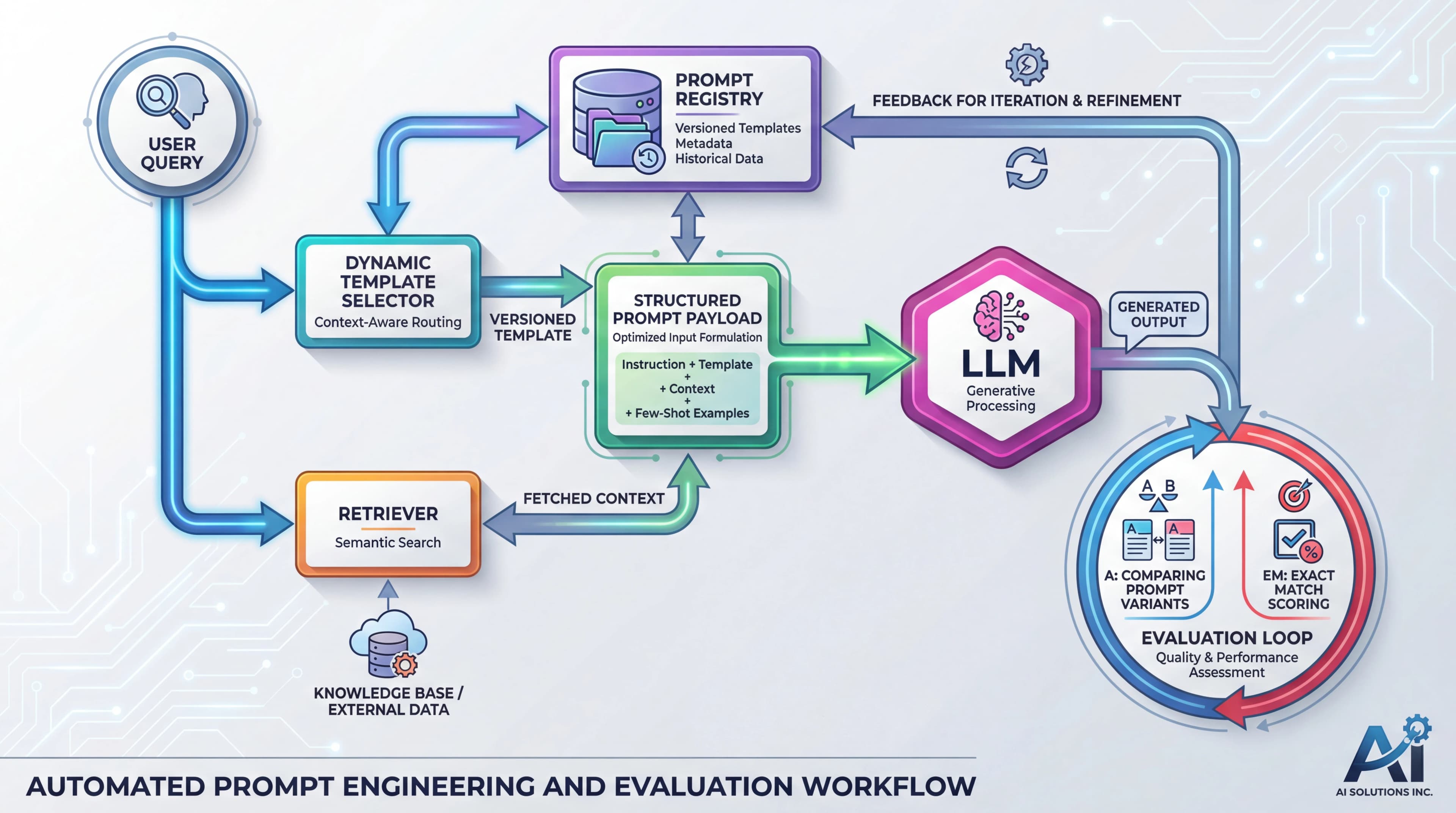 Advanced RAG Orchestration and Prompt Evaluation Workflow
Practical Implementations
Implementing a professional prompting strategy requires moving prompts out of the application code and into a managed infrastructure.
1. Template Versioning and SemVer
Prompts should be treated as immutable code artifacts. Using Semantic Versioning (SemVer) (e.g., v1.2.0) allows teams to:
- Roll back instantly if a new prompt variant causes regressions.
- Track performance over time across different model versions (e.g., GPT-4o vs. Claude 3.5 Sonnet).
- Prevent configuration drift where different environments (staging vs. production) use different prompt logic.
2. Managing the "Lost-in-the-Middle" Effect
In RAG systems, the order of retrieved context matters. Practical implementation involves:
- Re-ranking: Placing the most relevant chunks at the very beginning and very end of the prompt's data plane to exploit the model's primacy and recency biases.
- Context Distillation: Using a smaller model to summarize or filter retrieved chunks before injecting them into the main prompt to improve the signal-to-noise ratio.
3. Warehouse-Native Experimentation
Modern A (Comparing prompt variants) should occur where the data lives. By running prompt evaluations within the data warehouse (e.g., Snowflake, BigQuery), developers can:
- Maintain data privacy by not sending sensitive info to third-party eval tools.
- Leverage massive datasets for backtesting prompt changes.
- Apply statistical techniques like CUPED to reduce variance in evaluation results.
Advanced Techniques
Adaptive Instruction and Dynamic Few-Shotting
Instead of a static set of examples, dynamic prompting uses vector similarity to find the most relevant Few-Shot Examples for a specific user query. If a user asks about "Tax Law," the system dynamically injects tax-related examples into the prompt, significantly increasing the likelihood of an accurate, formatted response.
A: Comparing Prompt Variants at Scale
A (Comparing prompt variants) is the engine of optimization. Advanced teams use "Shadow Deployments" where a new prompt variant runs in parallel with the production prompt. The outputs are not shown to the user but are scored by an "LLM-as-a-Judge" or compared against EM (Exact Match) benchmarks. This allows for risk-free validation of prompt "upgrades."
The Role of EM (Exact Match) in Grounding
While semantic similarity is useful, EM (Exact Match) remains a critical metric for technical tasks. In RAG systems generating code, SQL, or specific identifiers, EM ensures the model hasn't hallucinated a single character, which is often the difference between a functional system and a broken one.
Research and Future Directions
The future of prompting lies in Optimization-as-a-Service. Research is moving toward systems like DSPy, which treat prompts as programs that can be compiled and optimized automatically.
- Self-Correcting Prompts: Systems that detect low-confidence outputs and automatically re-prompt the model with additional context or different instructions.
- Model-Specific Compilers: As models diverge in their "instruction following" styles, we will see compilers that take a generic intent and "compile" it into the optimal prompt structure for a specific model (e.g., XML tags for Claude vs. Markdown for GPT).
- Contextual Compression: Research into "Soft Prompts" and learned prompt embeddings that can compress thousands of tokens of context into a few dozen "virtual tokens," drastically reducing latency and cost.
Frequently Asked Questions
Q: How does "A" (Comparing prompt variants) differ from traditional software A/B testing?
Traditional A/B testing usually measures user behavior (clicks, conversions). In prompt engineering, A (Comparing prompt variants) focuses on model performance metrics like faithfulness, relevance, and EM (Exact Match). The "user" in this case is often an automated evaluation script or a critic model that determines which variant adheres better to the grounding data.
Q: Why is Template Versioning necessary if I'm using the same LLM?
LLM providers frequently update their models (e.g., "model-version-preview"). These updates can change how a model interprets specific instructions. By using Template Versioning, you can pin a specific prompt structure to a specific model version, ensuring that an update to the underlying LLM doesn't silently break your application's logic.
Q: Can Dynamic Prompting lead to higher costs?
Yes. Because dynamic prompting often involves injecting more context or few-shot examples based on the query, it can increase the token count per request. However, this is usually offset by the reduction in "hallucination costs"—the time and resources spent correcting or dealing with incorrect model outputs.
Q: When should I prioritize EM (Exact Match) over semantic similarity?
EM should be prioritized when the output must follow a strict schema, such as generating JSON keys, database IDs, or specific function calls. Semantic similarity is better for creative writing, summarization, or general chat where the "meaning" is more important than the specific syntax.
Q: How does RAG prompting solve the "U-shaped performance curve"?
The U-shaped curve describes how models struggle with information in the middle of a long prompt. RAG prompting solves this by Context Engineering: explicitly labeling chunks (e.g., [Source 1], [Source 2]), using clear delimiters, and instructing the model to cite its sources. This forces the model's attention mechanism to map specific parts of the output to specific parts of the input context.