TLDR
The validation of complex technical systems requires a dual-lens approach: Case Studies provide the qualitative "Ecological Validity" by documenting the "how" and "why" of implementation within messy, real-world contexts, while Benchmarks provide the quantitative "Ground Truth" through standardized metrics and reference points. This hub synthesizes these two disciplines into a unified validation framework. By integrating the "Three-Act" narrative of case studies with the rigorous taxonomy of benchmarking—ranging from internal baselines to Comparing prompt variants (A) for LLM optimization—architects can move beyond anecdotal evidence to achieve data-driven, context-aware system design.
Conceptual Overview
In the lifecycle of technical development, theory often meets reality with significant friction. The "Real-World Case Studies & Benchmarks" domain exists to bridge the gap between controlled experimentation and production-grade deployment.
The Duality of Validation
To understand a system's true performance, one must balance two distinct epistemological approaches:
- The Narrative Lens (Case Studies): Focuses on the "Three-Act" structure: Problem (Act I), Solution (Act II), and Result (Act III). It captures the "noise" of technical debt, organizational culture, and human error that benchmarks often ignore.
- The Metric Lens (Benchmarks): Focuses on the "North Star" of performance. It uses standardized tests to measure latency, throughput, or accuracy, providing a diagnostic framework to identify variance between current states and industry "gold standards."
The Feedback Loop
Benchmarks and case studies do not exist in isolation; they form a recursive feedback loop. A benchmark identifies a performance gap (e.g., high latency in a microservice). This triggers a case study to investigate the "why" (e.g., a specific architectural bottleneck or team communication failure). The resulting solution is then re-benchmarked to validate the improvement.
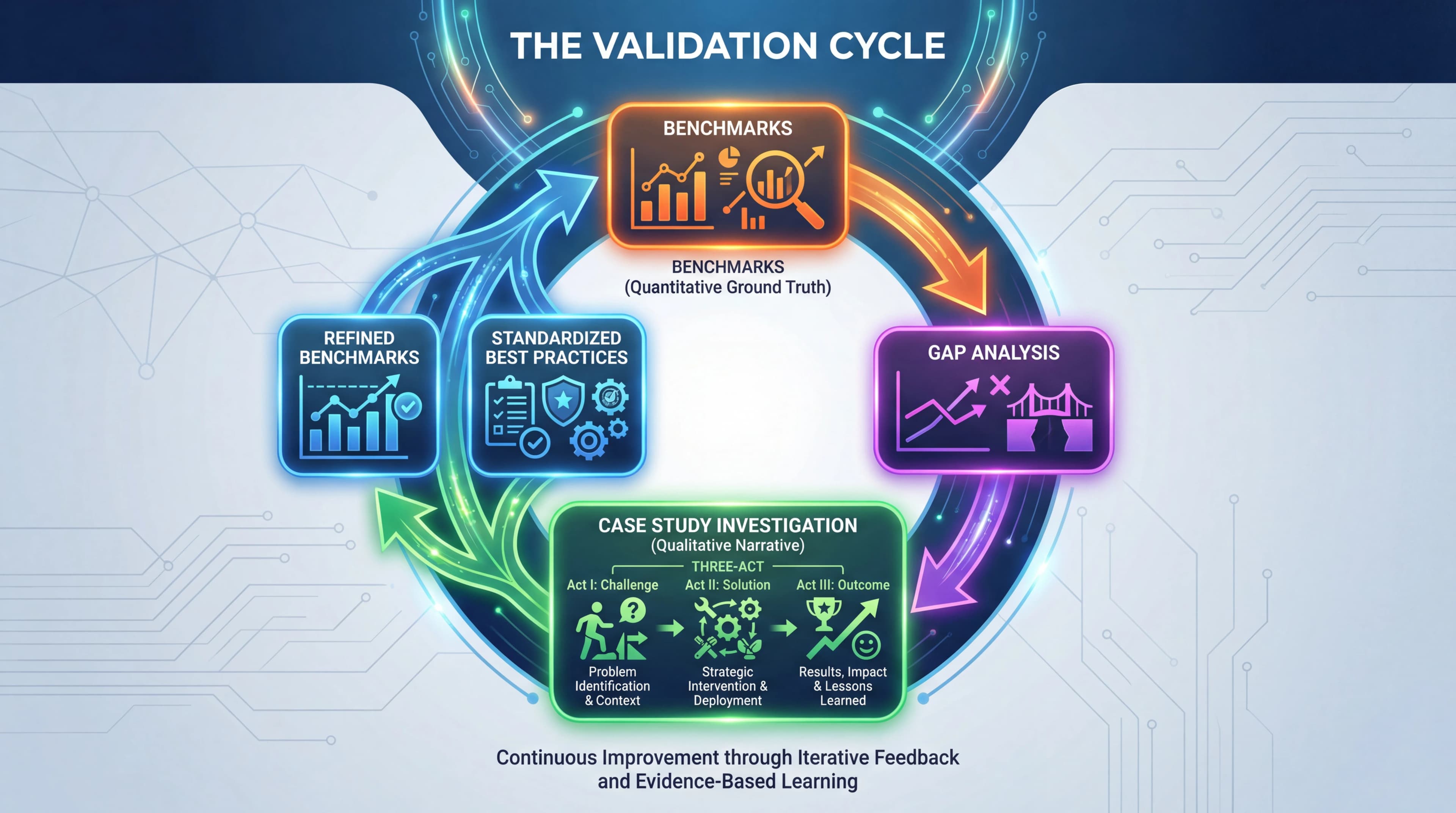 The Validation Cycle: Integrated Performance Framework
Infographic Description: A circular flow diagram. At the top, "Benchmarks" (Quantitative Ground Truth) feed into "Gap Analysis." This leads to "Case Study Investigation" (Qualitative Narrative), which documents the "Three-Act" implementation. The output of the Case Study feeds back into "Refined Benchmarks" and "Standardized Best Practices," closing the loop.
The Validation Cycle: Integrated Performance Framework
Infographic Description: A circular flow diagram. At the top, "Benchmarks" (Quantitative Ground Truth) feed into "Gap Analysis." This leads to "Case Study Investigation" (Qualitative Narrative), which documents the "Three-Act" implementation. The output of the Case Study feeds back into "Refined Benchmarks" and "Standardized Best Practices," closing the loop.
Practical Implementations
Implementing a robust validation strategy requires moving from abstract concepts to structured workflows.
1. Establishing the Benchmark (The Quantitative Baseline)
Before a case study can begin, a baseline must be established. This involves:
- Internal Benchmarking: Comparing current performance against historical data.
- Competitive Benchmarking: Measuring against industry peers.
- Task-Specific Benchmarking: In modern AI workflows, this frequently involves Comparing prompt variants (A). By systematically testing different prompt structures against a fixed evaluation set, engineers can quantify the impact of "prompt engineering" before documenting the broader implementation in a case study.
2. Executing the Case Study (The Qualitative Narrative)
Once the metrics are defined, the case study documents the journey.
- Act I: The Problem: Define the constraints. Was it a legacy system migration? A scaling bottleneck?
- Act II: The Solution: Detail the technical intervention. This is where the "Ecological Validity" shines—documenting why certain "best practices" were ignored in favor of pragmatic workarounds.
- Act III: The Result: Use the benchmarks established in step one to prove the outcome.
3. Cross-Pollination: The "Bench-Case" Hybrid
The most effective technical documentation uses benchmarks as the "evidence" within the "narrative" of the case study. For example, a case study on migrating to a serverless architecture is incomplete without a benchmark showing the change in cold-start latency and cost-per-invocation.
Advanced Techniques
For senior architects and researchers, validation extends into more complex methodologies:
Longitudinal Case Analysis
Unlike a snapshot case study, longitudinal analysis tracks a system over months or years. This reveals how benchmarks degrade over time (performance drift) and how organizational changes impact technical stability.
Triangulation
This involves using multiple data sources to validate a single finding. If a benchmark shows a 20% improvement, but the case study interviews with developers suggest increased friction, triangulation helps identify if the "improvement" came at the cost of developer experience (DX).
Automated Benchmarking Pipelines
In modern DevOps, benchmarking is no longer a manual event. Integrating performance tests into CI/CD pipelines allows for continuous Comparing prompt variants (A) and system stress-testing, turning every deployment into a mini-case study.
Research and Future Directions
The field is shifting toward "Observability-Driven Development."
- Dynamic Benchmarking: Moving away from static, once-a-year benchmarks toward real-time, production-traffic-based benchmarking.
- AI-Augmented Case Studies: Using LLMs to synthesize thousands of system logs and Jira tickets into cohesive "Three-Act" narratives, reducing the manual burden of documentation.
- The Rise of "Ecological" Simulators: Developing digital twins that simulate the "noise" of real-world environments (network jitter, human error) to provide more realistic benchmarks before production.
Frequently Asked Questions
Q: How do benchmarks prevent "survivorship bias" in case studies?
Benchmarks provide an objective baseline that applies to all projects, not just the successful ones. By comparing a failed project against the same benchmarks used for a successful one, organizations can identify exactly where the "Act II" solution diverged from the expected performance, turning a failure into a valuable learning case.
Q: Can a case study be considered valid without quantitative benchmarks?
While a case study can provide social or organizational insights without metrics, in technical fields, a lack of benchmarks severely limits its utility. Without a "Ground Truth" metric, it is impossible to determine if the "Solution" actually solved the "Problem" or merely shifted the bottleneck elsewhere.
Q: How does Comparing prompt variants (A) scale across different model architectures?
Comparing prompt variants (A) is highly architecture-dependent. A prompt that performs optimally on GPT-4 may fail on Claude 3 or a local Llama-3 instance. Advanced benchmarking requires "Cross-Model Sensitivity Analysis," where variants are tested across a matrix of models to find the most robust phrasing.
Q: What is the role of "Ecological Validity" in high-stakes systems like aerospace or medicine?
In high-stakes environments, "Clean Room" benchmarks are insufficient. Ecological validity ensures that the system works in the presence of "noise"—such as a surgeon being distracted or a cockpit being under high G-force. Case studies in these fields prioritize how the system fails and recovers in situ.
Q: How do we reconcile conflicting data between a benchmark and a real-world case study?
Conflicting data is often the most valuable output. If a benchmark says a database is "faster," but a case study shows "slower" real-world performance, it usually indicates a flaw in the benchmark's assumptions (e.g., it didn't account for network overhead or disk I/O contention in production). This leads to the development of more accurate, "ecologically valid" benchmarks.
References
- Yin, R. K. (2017). Case Study Research and Applications.
- State of DevOps Report (DORA).
- Standard Performance Evaluation Corporation (SPEC).