TLDR
Advanced Extensions represent the evolution of Retrieval-Augmented Generation (RAG) from static, text-centric pipelines into autonomous, multi-dimensional knowledge engines. This architectural shift is defined by four convergent pillars: Multi-Modal RAG, which aligns text, image, and audio into Joint Latent Spaces; Dynamic Knowledge Bases (DKB), which eliminate the "temporal gap" through real-time Change Data Capture (CDC); Personalization, which transforms generic retrieval into user-centric "digital twins"; and Meta-RAG, an orchestration layer that uses A (Comparing prompt variants) to self-optimize the entire system. Together, these extensions bridge the semantic and modality gaps, enabling enterprise AI to reason across heterogeneous data with sub-second freshness and hyper-relevant context.
Conceptual Overview
The current state of AI architecture is moving beyond the "Naive RAG" paradigm—a simple linear flow of query, retrieval, and generation. In its place, we are seeing the emergence of the Advanced Extension Stack, a modular framework designed to handle the complexity of real-world enterprise data.
To understand this shift, one must view the system as a living organism rather than a static database. Traditional RAG systems suffer from three primary "gaps":
- The Modality Gap: The inability to process information that isn't strictly text (e.g., security footage, voice memos, or technical diagrams).
- The Temporal Gap: The delay between a real-world event and its availability in the vector store (knowledge decay).
- The Semantic Gap: The distance between a user's ambiguous intent and the system's generic response.
The Systems View: A Layered Architecture
The Advanced Extensions hub addresses these gaps through a tiered approach:
- The Perception Layer (Multi-Modal RAG): This layer uses contrastive learning (e.g., CLIP) to project different data formats into a shared mathematical manifold. It allows the system to "see" and "hear" context, not just read it.
- The Vitality Layer (Dynamic Knowledge Bases): This acts as the system's nervous system, using CDC and WebSockets to ensure that the information retrieved is accurate as of the current millisecond.
- The Identity Layer (Personalization): By integrating SCIM/OIDC and session memory, the system builds a "Preference Vector" for every user, shifting the retrieval logic from $P(D | Q)$ to $P(D | Q, U)$.
- The Intelligence Layer (Meta-RAG): This is the brain of the operation. It monitors the RAG Triad (Precision, Faithfulness, Relevance) and performs A (Comparing prompt variants) to autonomously refine its own internal logic.
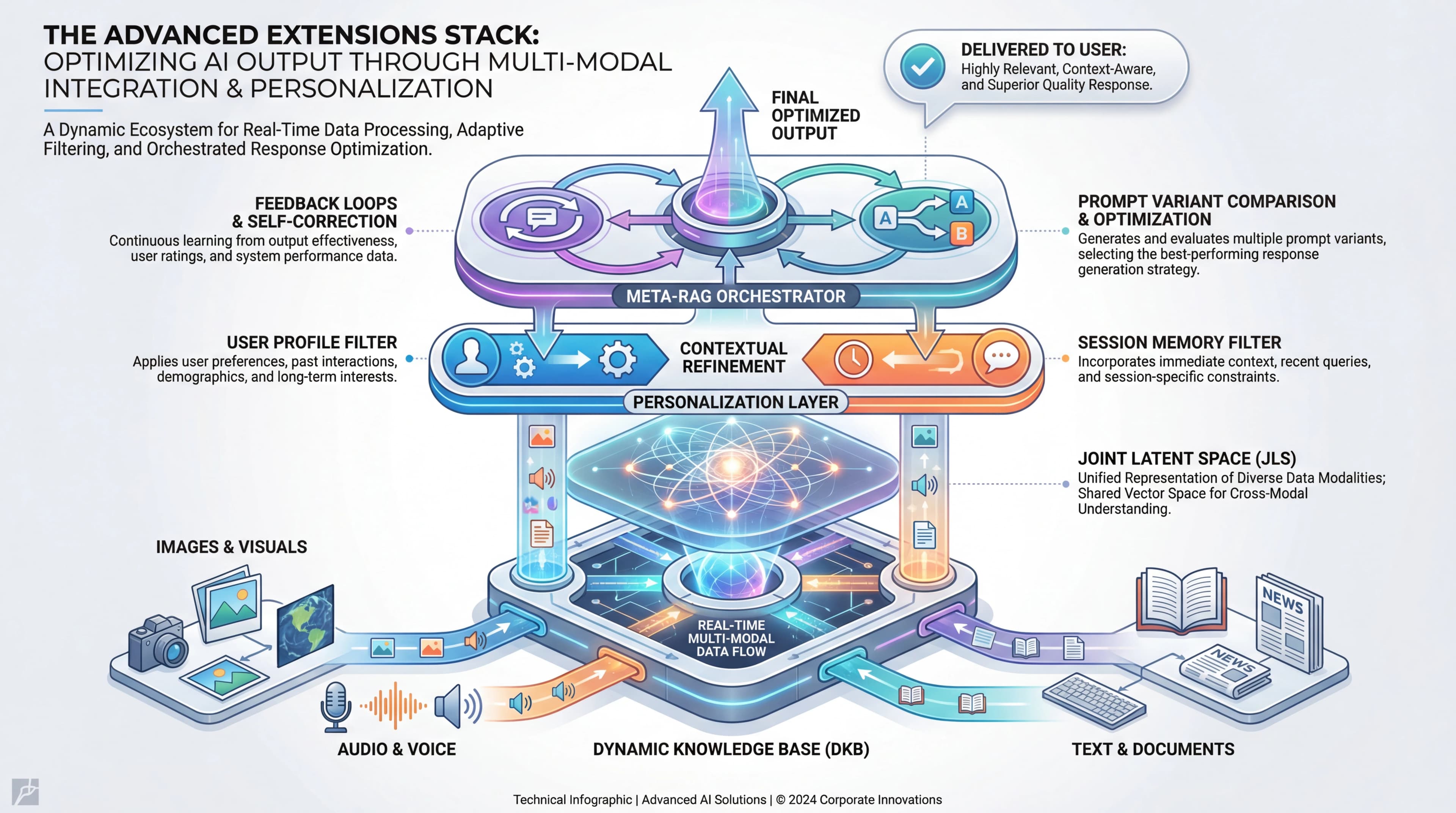 The Advanced Extensions Stack: Meta-RAG and Multi-Modal Architecture
Practical Implementations
Implementing these extensions requires a departure from standard ETL (Extract, Transform, Load) processes toward more sophisticated, event-driven architectures.
1. Multi-Modal Pipeline Engineering
To build a Multi-Modal RAG system, engineers must implement a "Decomposition and Alignment" pipeline. For video data, this involves temporal keyframe extraction and audio track separation. These assets are then passed through specialized encoders—Vision Transformers (ViT) for images and Conformer/Whisper models for audio. The critical step is the projection of these modality-specific vectors into a Joint Latent Space, where the vector for a visual "red car" is geometrically proximal to the text string "red car."
2. Real-Time Synchronization (DKB)
A Dynamic Knowledge Base relies on Change Data Capture (CDC). Instead of batch-processing data every 24 hours, the system listens to database transaction logs (e.g., via Debezium) and pushes updates to the vector store (e.g., Pinecone, Weaviate) in real-time. This requires a Knowledge Freshness Management (KFM) layer to handle TTL (Time-To-Live) for ephemeral data and prevent the "stale state" latency that plagues static systems.
3. The Personalization Stack
Personalization is implemented by bridging the gap between Identity Providers (IdP) and the retrieval engine. By utilizing User Profile Integration, architects can inject user-specific metadata (roles, past queries, preferences) into the retrieval step. This creates a Digital Twin of the user, allowing the system to prioritize documents that are not just relevant to the query, but relevant to that specific user's historical context.
4. Meta-RAG Orchestration
Meta-RAG is implemented as a "compiled" program. Using frameworks like DSPy, the system treats the RAG pipeline as a differentiable graph. It performs A (Comparing prompt variants) across thousands of iterations to find the optimal prompt structure and retrieval parameters (e.g., top-k, similarity thresholds) that maximize the RAG Triad metrics.
Advanced Techniques
The true power of these extensions lies in their cross-pollination. When these systems interact, they create capabilities that exceed the sum of their parts.
Multi-Modal Personalization
By combining Multi-Modal RAG with Personalization, a system can understand a user's visual preferences. For an architect, the system might prioritize technical blueprints in its retrieval; for a project manager, it might prioritize timeline charts—even if both users provide the same text query.
Self-Optimizing Dynamic Bases
Meta-RAG can be used to optimize the Knowledge Freshness Management of a DKB. By performing A (Comparing prompt variants), the Meta-RAG layer can determine if the system's response quality improves when it prioritizes "fresher" data over "more authoritative" but older data, effectively tuning the system's "metabolism" based on performance metrics.
Corrective Feedback Loops
Meta-RAG introduces the concept of Self-Correction. If the retrieval step returns low-precision results, the Meta-RAG layer can autonomously trigger a "re-query" or "query expansion" step, using the LLM to rewrite the user's prompt into a more effective vector search term before the final generation occurs.
Research and Future Directions
The frontier of Advanced Extensions is moving toward Agentic RAG and Continuous Learning (CL).
- Agentic RAG: Future systems will not just retrieve data; they will use tools to generate new data or perform actions (e.g., calling an API to get a real-time stock price) when the internal Knowledge Base is insufficient.
- Catastrophic Forgetting Mitigation: A major research area in DKBs is how to incrementally update model weights with new data (Continuous Learning) without losing the foundational knowledge the model was originally trained on.
- Privacy-Preserving Personalization: As systems become more personalized, the need for Differential Privacy and Federated Learning grows. The goal is to provide a "batch size of one" experience without compromising the raw PII (Personally Identifiable Information) of the user.
Frequently Asked Questions
Q: How does Multi-Modal RAG handle the "modality gap" in a Dynamic Knowledge Base?
Multi-Modal RAG uses Joint Latent Spaces to align different data types. In a DKB, this alignment must happen in real-time. As new images or videos are ingested via CDC, they are immediately encoded and projected into the shared space. The "gap" is minimized by using high-throughput encoders and ANN (Approximate Nearest Neighbor) indexing, ensuring that a new video frame is searchable via text query within milliseconds of ingestion.
Q: What is the specific role of A (Comparing prompt variants) in Meta-RAG?
In Meta-RAG, A (Comparing prompt variants) is used to move away from manual "vibe-checks." The system automatically generates multiple versions of a prompt (e.g., changing the instructions for how to use retrieved context) and tests them against a validation set. The variant that yields the highest Faithfulness and Context Precision scores is then "compiled" into the production pipeline.
Q: How do you balance data freshness in a DKB with retrieval latency?
This is managed through Knowledge Freshness Management (KFM). High-velocity data is often stored in a "Hot Tier" (in-memory cache or specialized real-time index), while archival data sits in a "Cold Tier." The retrieval engine queries both, but the Meta-RAG layer can be tuned to weight the "Hot Tier" results more heavily for time-sensitive queries, ensuring freshness without the overhead of re-indexing the entire corpus.
Q: Can Personalization lead to "Filter Bubbles" in enterprise RAG?
Yes. If the Preference Vector is too strong, the system may ignore relevant but "unpreferred" information. To mitigate this, architects use Exploration vs. Exploitation strategies, where a small percentage of retrieved results are intentionally "generic" or "diverse" to ensure the user isn't cut off from the broader organizational knowledge base.
Q: What are the hardware requirements for scaling Multi-Modal RAG?
Multi-Modal RAG is significantly more compute-intensive than text-only RAG. It requires GPU-accelerated ETL pipelines for real-time video/audio encoding (e.g., NVIDIA L4s or A100s). Additionally, the vector database must support high-dimensional vectors (often 768 or 1024 dimensions) and provide efficient HNSW indexing to maintain sub-second retrieval speeds across millions of multi-modal assets.
References
- CLIP: Learning Transferable Visual Models from Natural Language Supervision
- RAGAS: Automated Evaluation of Retrieval Augmented Generation
- Change Data Capture (CDC) Patterns in Distributed Systems