TLDR
Recursive Language Models (RLMs) solve the fundamental limitation of "context rot"—the performance degradation observed in LLMs as prompts approach their physical context limits. By treating long prompts as external variables within a Python REPL (Read-Eval-Print Loop), RLMs allow models to programmatically search, slice, and recursively process data. This approach extends the effective context window by up to 100x (reaching 10M+ tokens) and outperforms standard frontier models by over 30% on complex reasoning tasks like ULong, often at a lower total API cost.
Conceptual Overview
The current trajectory of Large Language Model (LLM) development focuses heavily on expanding the physical context window (e.g., 128k, 200k, or 1M tokens). However, research into "context rot" suggests that as the context window fills, the model's ability to reason over that information degrades significantly. This is often referred to as the "Lost in the Middle" phenomenon, where models struggle to retrieve or synthesize information located in the center of a massive prompt.
The Problem: Context Rot and Quadratic Complexity
Standard Transformer architectures rely on self-attention mechanisms that, in their vanilla form, scale quadratically with sequence length. Even with optimizations like FlashAttention or Ring Attention, the KV cache (Key-Value cache) becomes a massive memory bottleneck. More importantly, the "effective" context window—the range over which a model maintains high reasoning accuracy—is typically much smaller than its "physical" limit.
The Solution: Symbolic Interaction
Recursive Language Models (RLMs) propose a shift from ingestion to interaction. Instead of stuffing 10 million tokens into the model's active memory, the RLM treats the prompt as a variable in an external environment (a Python REPL).
This draws inspiration from out-of-core algorithms in computer science, where systems with limited fast memory (RAM) process massive datasets by cleverly swapping data from slow storage (Disk). In this analogy:
- The LLM is the CPU/Fast Memory.
- The Python REPL is the Disk/External Environment.
- The Prompt is the Dataset.
By allowing the LLM to write Python code to grep, slice, or regex the prompt, the model can narrow its focus to specific, relevant snippets before performing a recursive call on that subset.
Infographic: The RLM Workflow
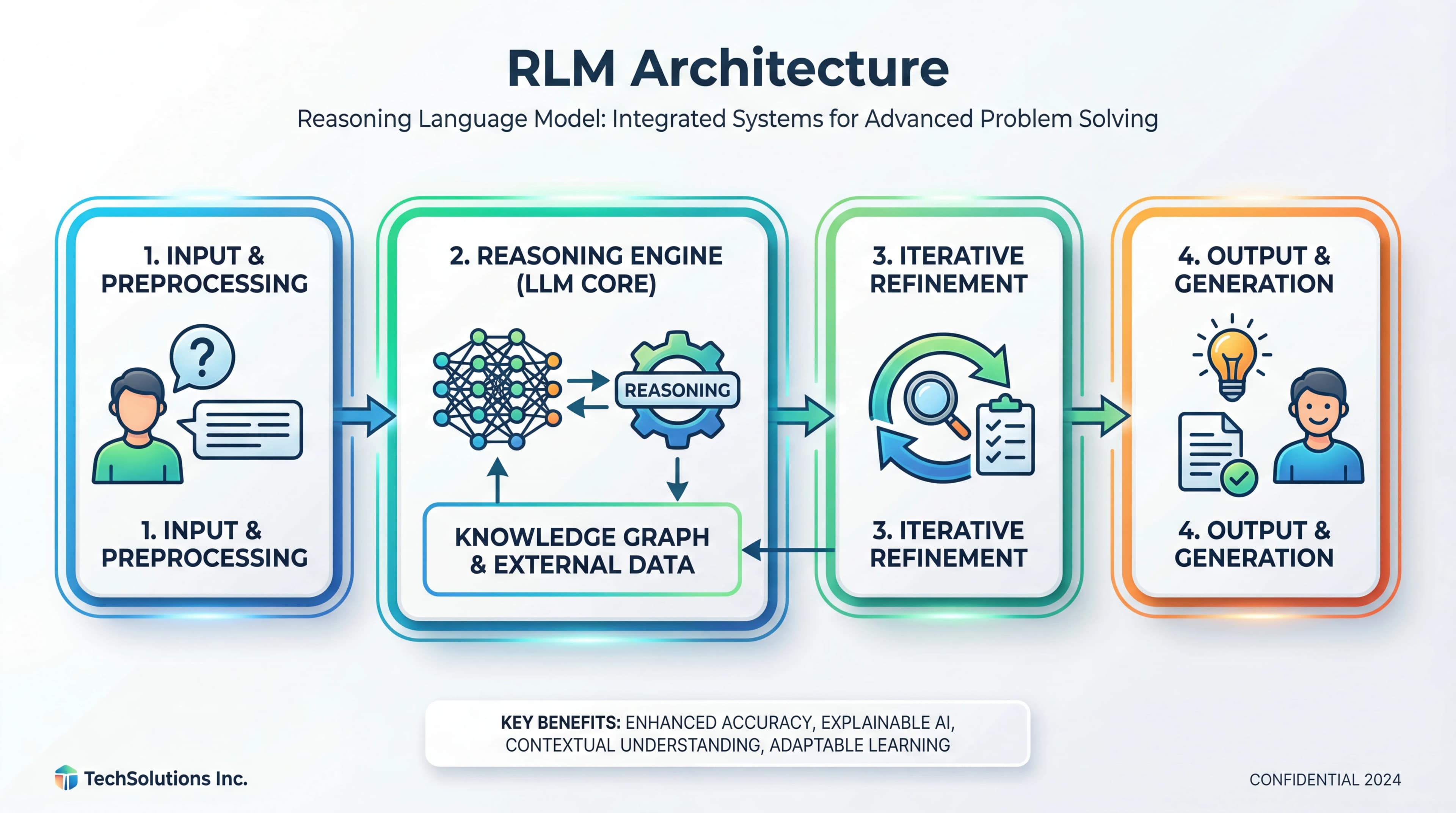 Reinforcement Learning Model (RLM) System Architecture
Description: A diagram showing a Root LLM receiving a 10M token prompt. Instead of reading it, the Root LLM writes Python code to store the prompt as a variable
Reinforcement Learning Model (RLM) System Architecture
Description: A diagram showing a Root LLM receiving a 10M token prompt. Instead of reading it, the Root LLM writes Python code to store the prompt as a variable P. It then executes a search (e.g., P.find("Section 2")), extracts a 5k token snippet, and passes that snippet to a Sub-LLM call to perform a specific task like NER (Named Entity Recognition).
Practical Implementations
The official implementation of RLMs, available via the alexzhang13/rlm repository, utilizes a scaffolding approach that can be applied to any frontier model (GPT-4o, Claude 3.5 Sonnet, or Qwen-2.5-Coder).
The RLM Components
- The Root LLM: The high-level orchestrator (e.g., GPT-4o) that analyzes the user's query and determines the strategy for dicing the context.
- The REPL Environment: A persistent Python interpreter where the prompt is loaded as a string variable.
- The Sub-LLM: A potentially smaller, faster model (e.g., GPT-4o-mini or Claude Haiku) used for the recursive "worker" tasks.
- Recursive Decomposition: The process of breaking a "Global" query into "Local" sub-queries that fit within the Sub-LLM's high-performance context range.
Implementation Example: Legal Due Diligence
Imagine a 200-page merger agreement. A standard LLM might miss a specific "Change of Control" clause buried on page 142. An RLM would:
- Load the 200-page document into the REPL as
doc. - Write code:
[idx for idx, line in enumerate(doc.split('\n')) if "change of control" in line.lower()]. - Identify the specific line numbers and extract the surrounding paragraphs.
- Recursively call a Sub-LLM to analyze only those paragraphs.
- Synthesize the final answer for the user.
When Comparing prompt variants (A), RLMs often choose strategies that prioritize programmatic filtering over semantic retrieval (RAG), as programmatic filters are deterministic and less prone to the "hallucinated retrieval" common in vector databases.
Advanced Techniques
RLMs excel in tasks where information density is high and dependencies are non-local.
Handling Information Density: The ULong Benchmark
The ULong benchmark tests a model's ability to reason over tasks where the answer depends on almost every line in the prompt (e.g., "Sum all the transaction values in this 50,000-line ledger").
- Base LLMs: Fail catastrophically as the ledger grows, because they cannot maintain the "running sum" accurately across a massive context.
- RLMs: Use the REPL to iterate through the ledger in chunks, maintaining a stateful variable in Python to track the sum. This allows for 100% accuracy regardless of document length.
Multi-Hop Reasoning: BrowseComp+
In multi-hop tasks, the answer to Question A is required to find the answer to Question B. RLMs handle this by using the REPL as a "scratchpad." The model can store the result of the first recursive call as a Python variable and then use that variable to construct the search query for the second call.
Cost Efficiency and Performance
One of the most surprising results from the RLM research is that it is often cheaper than standard long-context calls.
- Standard Call: You pay for the full 1M tokens in every turn of the conversation.
- RLM Call: You pay for the Root LLM's orchestration (small) and the Sub-LLM's processing of small, targeted snippets.
On the BrowseComp+ benchmark, RLMs achieved a 29% performance improvement over summarization baselines while maintaining a lower average cost per query.
Research and Future Directions
While RLMs provide a massive leap in effective context, several areas remain for optimization.
Asynchronous Recursion
Current implementations are largely synchronous—the Root LLM waits for the Sub-LLM to return before proceeding. Future iterations could implement Asynchronous Sub-calls, allowing the Root LLM to spawn a "swarm" of Sub-LLMs to process different parts of a document simultaneously. This would drastically reduce latency for massive synthesis tasks.
Specialized Training
Most RLMs today use "off-the-shelf" models. However, training a model specifically to use the REPL—teaching it to be more "conservative" with sub-calls or more "aggressive" with regex filtering—could unlock even higher performance. This involves fine-tuning on trajectories of successful recursive reasoning.
Depth of Recursion
The research currently focuses on a recursion depth of 1 (Root -> Sub). Exploring deeper trees (Root -> Manager -> Worker) could allow for the processing of truly astronomical datasets, such as entire corporate wikis or multi-million line codebases, without ever needing a physical context window larger than 128k tokens.
Frequently Asked Questions
Q: How is an RLM different from RAG?
A: RAG (Retrieval-Augmented Generation) relies on semantic similarity (vector embeddings) to find relevant chunks. RLMs use symbolic interaction (Python code) to slice the context. RLMs are better for tasks requiring logical coherence across the whole document, whereas RAG is better for "finding a needle in a haystack" where the needle is semantically distinct.
Q: Does using an RLM increase latency?
A: Yes, because it involves multiple sequential LLM calls and code execution. However, for complex tasks that a standard LLM would fail, the trade-off of "slower but correct" vs. "fast but wrong" is usually acceptable.
Q: What is "Context Rot"?
A: Context Rot refers to the phenomenon where an LLM's reasoning, instruction-following, and retrieval capabilities degrade as the number of tokens in its prompt increases, even if it stays within the model's technical limit.
Q: Can I run RLMs locally?
A: Yes. Since RLMs are a scaffolding strategy, you can use local models like Llama 3 or Qwen-2.5-Coder as the Root and Sub models, provided you have a Python execution environment (like a Docker sandbox) for the REPL.
Q: Is the Python REPL safe?
A: In production environments, the REPL must be sandboxed (e.g., using E2B or a restricted Docker container) to prevent the LLM from executing malicious code on the host system.
References
- https://github.com/alexzhang13/rlm
- https://arxiv.org/pdf/2512.24601