TLDR
Semantic super-resolution is the practice of restoring or supplying the structural constraints that guide correct interpretation when raw data, limited context, or smaller models lack sufficient resolution. Rather than making outputs sharper or more verbose, it augments low-resolution reasoning with externally generated, higher-resolution semantic structure. In RAG and reasoning-first architectures, this involves retrieving reasoning posture—the rules and boundaries of logic—rather than just raw content.
Conceptual Overview
From Pixel Super-Resolution to Semantic Super-Resolution
In computer vision, traditional super-resolution enhances low-resolution images into high-resolution ones. However, naïve approaches often produce "hallucinations"—visually plausible details that violate semantic truth. Semantic super-resolution addresses this by conditioning enhancement on what the image represents (labels, spatial grounding), ensuring added detail remains faithful to meaning.
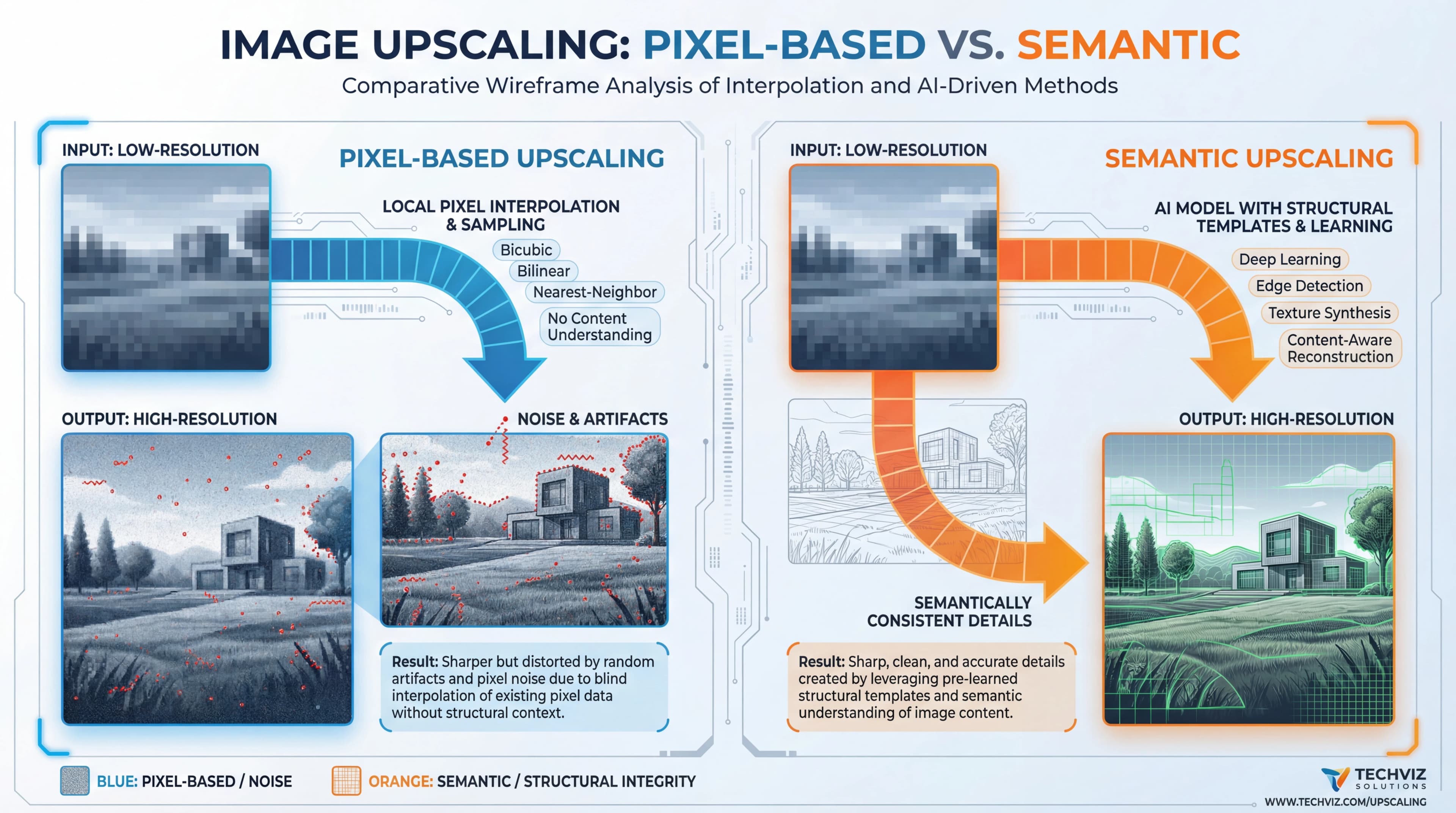 Pixel-Based vs. Semantic Image Upscaling Comparison
This failure mode translates directly to language models. Small models or those with constrained context often lack the "resolution" to infer complex constraints from raw text. Semantic super-resolution shifts the burden from generation to conditioning: the system is guided by what must be preserved, preventing the model from filling gaps with statistically plausible but structurally invalid content.
Resolution in Reasoning Systems
Reasoning resolution is a systems property, not just a model property. It reflects how many constraints, relationships, and conditionals a system can hold in working memory.
- Low-resolution reasoning: Flattens exceptions, overgeneralizes rules, and erases uncertainty.
- High-resolution reasoning: Preserves applicability boundaries, priority relations, and explicit unknowns.
By externalizing and reintroducing structure at inference time, semantic super-resolution increases effective reasoning resolution without increasing model size.
Practical Implementations
Semantic Super-Resolution in Vision
Systems like SeeSR and Spatially Re-focused Super-Resolution (SRSR) pair low-resolution images with semantic tags. They ground text tokens to spatial regions and constrain cross-attention so that meaning guides the enhancement while suppressing hallucinations in unanchored regions.
Semantic Super-Resolution in Language and RAG Systems
In language systems, this is achieved by pairing retrieved text with externally generated reasoning scaffolds. Instead of retrieving a raw document chunk, the system retrieves the text alongside its applicability conditions, exceptions, and hierarchical context.
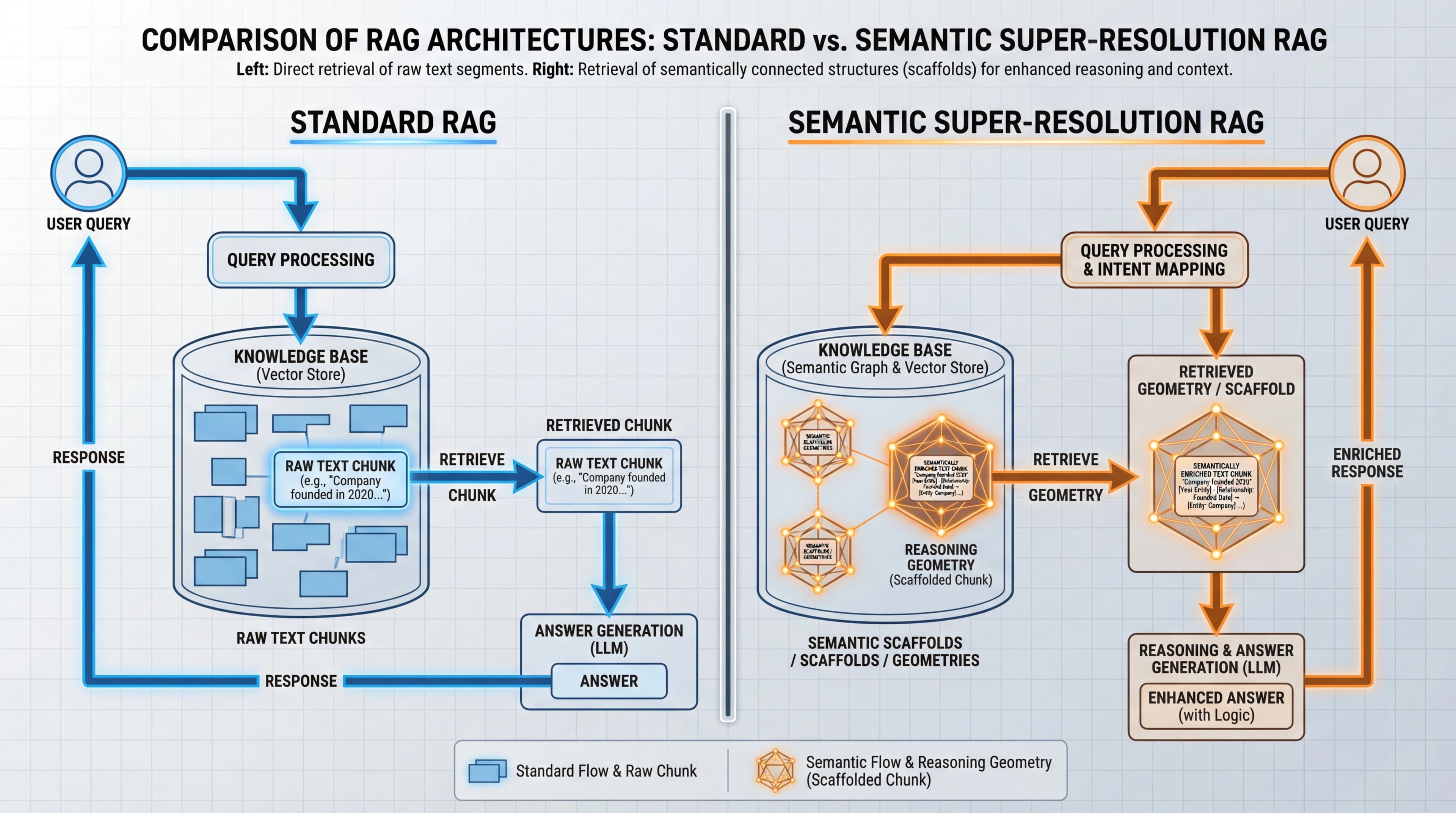 Standard RAG vs. Semantic Super-Resolution RAG Architecture
These artifacts define a local geometry of reasoning. The retrieved text provides the substance, while the retrieved structure provides the shape. This metadata conditions inference, preventing the model from having to reconstruct reasoning on the fly.
Reasoning Posture as the Unit of Resolution
The operative unit here is reasoning posture: the set of permitted assumptions, required facts, and rule priorities. Posture acts as the semantic equivalent of spatial grounding, determining where inference is allowed to go and where it must stop.
Advanced Techniques
Multi-Representation Conditioning
High-fidelity systems benefit from multiple aligned representations of the same structure, such as natural language rules, decision trees, pseudo-code, and constraint graphs. Agreement across these formats increases confidence in the structure, while divergence highlights ambiguity.
Hierarchical and Mycelial Resolution
Semantic structure is rarely flat. It is hierarchical (parents constrain children) and mycelial (exceptions override defaults).
 Infographic: A wireframe visualization of "Mycelial Resolution". It shows a central node representing retrieved information connected to a network of parent constraints (nodes above) and sibling exceptions (nodes to the sides). Lines connect the nodes, illustrating the flow of constraints and exceptions. The entire structure resembles a root system.
Semantic super-resolution involves retrieving connected "neighborhoods" of structure so inference proceeds through a network of permissible reasoning rather than a linear chain of tokens.
Controlling Hallucination via Constraint Injection
Hallucination is often a symptom of absent constraints. By injecting "applies when" and "does not apply when" boundaries, the system reduces the model's degrees of freedom. This makes hallucination a visible signal of missing or conflicting structure rather than a failure of imagination.
Research and Future Directions
Measuring Semantic Super-Resolution
Future evaluation metrics must move beyond output quality to ask:
- Are invalid reasoning paths pruned earlier?
- Do conclusions change appropriately when premises change?
- Does uncertainty remain visible under pressure?
- Can smaller models match larger models when supplied with structure?
Toward Reasoning-Conditioned Inference
This paradigm suggests a shift in AI design: moving from larger models to better-conditioned models, and from prompt verbosity to structural guidance. Reasoning capability becomes something a system supplies to a model, rather than something the model must inherently possess in its weights.
Frequently Asked Questions
Q: What is the core idea behind semantic super-resolution?
It is the practice of restoring or supplying structural constraints (like rules and boundaries) to guide an AI's interpretation, especially when the model or data lacks the resolution to infer those constraints independently.
Q: How does semantic super-resolution differ from traditional super-resolution?
Traditional super-resolution focuses on pixel-level statistics to sharpen images, which can cause hallucinations. Semantic super-resolution conditions the enhancement on the meaning and structure of the data to ensure fidelity to the truth.
Q: How does this technique improve RAG systems?
Instead of just retrieving raw text chunks, it retrieves "reasoning scaffolds"—metadata containing applicability conditions, exceptions, and priorities—which provide a geometric shape for the model's inference.
Q: What is "reasoning posture"?
Reasoning posture is the set of assumptions, facts, and rules that define the boundaries of a model's logic. It determines where a model is allowed to reason and where it must withhold a conclusion.
Q: Can semantic super-resolution help smaller AI models?
Yes. By externalizing reasoning structure and injecting it at inference time, smaller models can achieve higher reasoning resolution, matching the performance of larger models without an increase in parameter count.